Beginner’s Guide to Keeping Venomous Snakes
by Lenny Flank, Jr
Red and Black Publishers, St Petersburg, Florida
NOTE:
Snake handling is extremely
dangerous. This
book is presented for informational
purposes only.
It
is not intended to serve as a course or instruction in the art of handling
venomous snakes. It is impossible to learn how to safely handle venomous snakes from a
book. If you want to learn how to
safely handle venomous snakes, find an experienced snake handler who can give
you practical hands-on training. And
if you
don’t know what you are doing, don’t try anything you see in this book. Don’t
be stupid.
© Copyright
2008 by Lenny Flank, Jr
All rights
reserved
Library of Congress Cataloging-in-Publication Data
Flank, Lenny.
Beginner's guide to
keeping venomous snakes / by Lenny Flank, Jr.
p. cm.
ISBN
978-1-934941-17-1
1.
Snakes as pets. 2. Poisonous snakes. I.
Title.
SF459.S5F57 2008
639.3'96--dc22
2008013586
Red
and Black Publishers, PO Box 7542, St Petersburg, Florida,
33734
Contact
us at: info@RedandBlackPublishers.com
Printed
and manufactured in the United States of America
All photos by author.
Contents
Introduction 5
Things to keep in mind
7
Devenomed snakes
10
Basic Safety
Rules
13
Housing
17
Handling
25
Snake hooks
27
L-hooks 31
Tailing 31
Grabsticks 33
Pinning Stick
35
Tubes 39
Squeeze box
40
Snake shields
41
Holding bins
42
Forceps 44
Catchboxes 44
Bagging methods
46
Bagging bucket
47
Bagging frame
49
Bagging stick
50
Un-bagging a snake
53
Types of
Snakes
57
Learn From
These Mistakes 65
Snakebite; If
You Flub Up
69
Conclusion
79
Introduction
When
I first told a few friends and family members that I was working on a booklet
demonstrating the proper techniques for keeping venomous snakes, the reaction
was immediate, unanimous and predictable: “Omigod!!
Some kid is gonna read it and get himself killed!!!!!”
“Isn’t it dangerous to put information like that out to the
public???” “You’re
gonna get sued!!!”
So why write about keeping venomous snakes?
My primary reason, ironically, is to discourage inexperienced people from trying it.
Over the past ten years, the hobby of herpetoculture has grown
exponentially. Predictably, as the
interest in snakes and other reptiles has grown, so too has the interest in
venomous snakes (known to afficionados as “hot” snakes).
As a reptile writer, I get several requests every month from people who
want to know about keeping rattlesnakes or cobras or whatever.
Virtually every local herpetological society in the United States has its
contingent of “fang freaks”. A
surprising number of venomous species are being captive bred by amateur
enthusiasts, and a number of venomous breeders and dealers can be found on the
Internet and through ads in the reptile hobby magazines.
Venomous snakes are also readily obtainable at local herp swaps and
shows, as well as at the national reptile expo held in eastern Pennsylvania
twice each year.
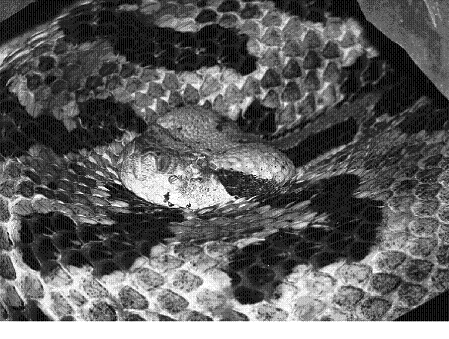
Venomous
snakes, like this Timber Rattlesnake, are more widely available to amateur
keepers than you might think.
This increase in the availability of venomous snakes has unfortunately
not been matched by a corresponding increase in the availability of good
practical information about keeping them. Many
of these serpents are being purchased by inexperienced people who have no real
idea what they are getting into, and no real idea how to go about the business
of keeping a potentially dangerous or lethal snake.
The primary purpose of this booklet is to give that information, to let
every potential hot keeper know, up front, exactly what he or she is getting
into. Again and again, I will
emphasize that keeping hot snakes is serious business, not to be entered into
lightly. Your first mistake may
very well be your last.
I pull no punches here. This is not a game.
These snakes can kill. While
every keeper has his or her own individual way of doing things, I will be blunt
here about what works for me and what doesn’t, and why.
I’ll also be blunt about the consequences of a mistake.
This is not done for the purposes of sensationalism; it is done to show
everyone, clearly and coldly, what happens if you flub up.
If you make a mistake with a venomous snake, there is no second chance.
Although
many herpers develop an interest in hots, and many of these may decide that they
might want to give it a try, I have found that most prospective hot keepers lose
interest once they learn how much equipment, money and knowledge is actually
necessary, and once they really deeply understand what the real-world
consequences of a single mistake could be.
In
effect, if you are thinking about keeping venomous snakes, the goal of this
booklet is to try and talk you out of it.
If,
however, despite my efforts to talk you out of it, you do join the ranks of the
“fang freaks”, I hope that the information here will serve as a useful
supplement, as your “snake mentor” shows you the ropes and gives you live
hands-on experience under a watchful eye.
Most
of the methods depicted here are not flashy (and I strongly discourage anyone
from trying the ones that are). You
will not look like “The Crocodile Hunter” as he casually carries lethal
snakes around by the tail. By
nature, I am a very cautious and conservative snake keeper.
I do not mess with snakes I am not comfortable with, and I do not give
the snakes I do mess with the opportunity to poke any holes anywhere in me.
I suppose that is why I am still alive, and still have all my fingers and
toes. Some of my snake-keeping
acquaintances do not.
Things to Keep in Mind
First things
first. Here are some things that
every potential hot keeper must consider before
he or she gets that first snake.
(1) Why do you want to keep a venomous snake? For use in educational shows or talks? Captive breeding for conservation? Or because it shows the world what a macho kind of guy you
are? If you want to keep a hot
snake because it's “cool” or to impress people, then you are not ready to
keep them at all. Go take karate
lessons instead.
(2)
Where are you going to get your hot snake?
Catch it yourself? In many
areas that’s illegal. It can also
kill you if you don’t know what you are doing.
And if you need to ask where you can buy a venomous snake, then you’re
not ready to be keeping one.
(3)
How much snake experience do you have? Keeping
a venomous snake is not the same as keeping a corn snake or ball python or even
a burmese python. Can you work with
a really nasty snake like a water snake or coachwhip, regularly, routinely, and
reliably without getting bitten? If you can’t go at least a year without being bitten by a
coachwhip, racer or something similar, you’re not ready to be handling hot
snakes.
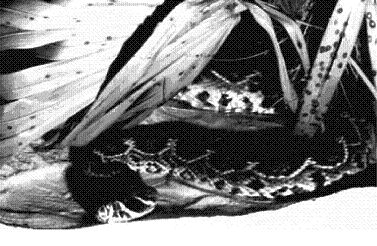
If
you are keeping a venomous snake, like this Eastern Diamondback Rattlesnake, be
sure you are doing it for the right reasons.
(4)
Is it legal to keep a venomous snake where you live? Many localities have laws against dangerous animals in
general or venomous snakes in particular. Usually
these are passed after some bonehead gets bitten by his pet puff adder or
something. Don't even try
to keep a hot snake where it isn’t legal to do so. When anything happens, having your snake confiscated and
destroyed is about the best
you can hope for. You might just
find your butt in the slammer. And
in any case the reptile hobby doesn’t need the bad publicity that will result
from your stupid actions.
(5)
Can you properly house a venomous snake? A
single-piece sliding door cage, designed to be escape-proof, is an absolute
necessity for keeping any venomous snake, and they are not cheap.
That aquarium with a screen lid on top, weighted down with a couple of
bricks, won’t cut it. In addition, your “hot room” will need to be modified to
make it absolutely 100% escape-proof, and that can require some modifications to
the door, windows and baseboards. Can’t
afford secure housing? Then you
can’t afford the snake.
(6)
Do you live in a place where others can be potentially exposed to the snake?
Perhaps you think you know
enough to handle a hot snake without being bitten, and perhaps you are willing to
risk death/disfigurement—but what about your spouse, your kids, or your
neighbors? When your snake bites
anybody around you, you can expect some very nasty legal actions that will
occupy you for a good chunk of your life. Better
have lots of liability insurance, and keep it paid up.
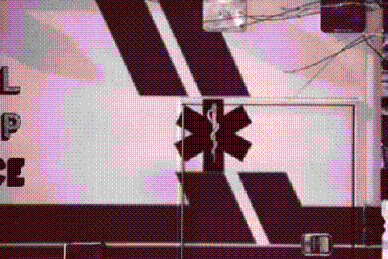
Every
venomous snake keeper should expect to be bitten at some point in time, and plan
accordingly.
(7)
Who is your “mentor”? Which
experienced hot snake keeper is available for you to learn firsthand, under a
watchful eye, how to use a snake stick, how to use a catchbox, how to do such
routine tasks as feeding and cleaning? If
you think you are going to learn this “on your own”, forget it.
You’ll be nothing but a danger to yourself and others.
(8) What are your plans for handling the snake when it comes time for
things like changing the water and feeding?
Who can you trust to be your partner, to be there every time you open the
snake cage? Who will, in the event
of an accident, have the necessary experience to handle and confine the snake so
it doesn’t escape? Planning on
doing this yourself? What happens
when you collapse on the floor instead?
(9)
What about when you get bitten? Does
the hospital have a ready supply of antivenom for the species you want to keep?
Don’t even think about depending
on the local zoo for your supply—they need it themselves, and they don’t
appreciate having some bozo taking their entire supply of antivenom to save his
sorry butt (meanwhile leaving the zoo staff without any antivenom in case they have an accident).
(10)
How’s your bank account? Antivenom
alone runs several hundred dollars per vial, and a really serious bite can
require as many as twenty or twenty five vials. Plus you’ll have to pay the good doctor, the lab bills, the
cost of a hospital bed, etc etc etc. You
should plan on leaving at least $15,000 in the bank at all times.
When you get seriously bitten, you’ll need it.
(11)
What if the snake gets sick? Do you
have an experienced veterinarian near you that will be willing to treat your
snake if it gets an infection, or if it retains an eyecap, or has an incomplete
shed?
Let me be blunt. Venomous
snakes kill people. There is
nothing theoretical about that. If
you are deluding yourself into thinking “I’ll never get bit”, think again.
It will happen. Count on it.
Being dead lasts for a long time.
Don’t be stupid. If you can’t deal seriously and thoroughly with every one
of the concerns listed above, then you're not ready to keep a venomous snake.