The
Titanic Reports
The
Official Conclusions of the 1912 Inquiries Into the Titanic Disaster by
the US Senate and the British Wreck Commissioner
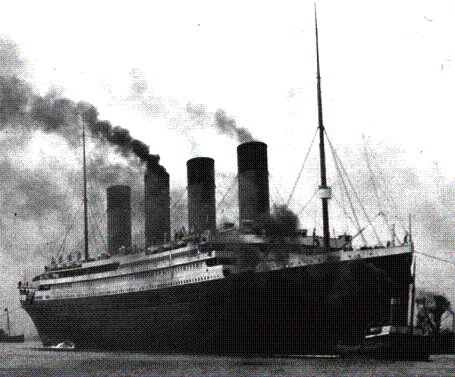
Red
and Black Publishers, St Petersburg, Florida
Report
Of The Committee On Commerce United States Senate Pursuant To S. Res. 283
Directing The Committee On Commerce To Investigate The Causes Leading To The
Wreck Of The White Star Liner Titanic.
Originally published 1912
Library of Congress Cataloging-in-Publication Data
The Titanic reports : the official conclusions of
the 1912 inquiries
into the Titanic disaster / by the US Senate and the British Wreck
Commissioner.
p. cm.
ISBN 978-1-934941-11-9
1. Titanic (Steamship)--Sources. 2.
Shipwrecks--North Atlantic
Ocean--Sources. I.
United States. Congress. Senate. Committee on Commerce.
"Titanic" disaster II. Great Britain. Court to investigate loss of
steamship "Titanic".
Proceedings before the Right Hon. Lord Mersey, wreck
commissioner of the United
Kingdom ...
VK1255.T6T58 2008
910.9163'4--dc22
2008009879
Red
and Black Publishers, PO Box 7542, St Petersburg, Florida,
33734
Contact
us at: info@RedandBlackPublishers.com
Printed and manufactured in the United States of America
Preface
The American Congressional inquiry into the sinking of the Titanic,
in April 1912, very nearly did not take place – and the reasons were legal and
economic.
When the world learned, on the morning of April 15, 1912,
that the Titanic had struck an iceberg and sunk, Michigan Senator William
Alden Smith paid particular attention to the press reports.
Senator Smith had previously met the Titanic’s captain, William
J. Smith (no relation) on another vessel, during a trans-Atlantic trip in 1906.
By late afternoon, Senator Smith became more and more disturbed by the
details he was seeing in the press reports – not enough lifeboats for all the
passengers, the Titanic perhaps ignoring ice warnings and traveling at
excessive speed. The White Star
Line that owned the Titanic, Senator Smith knew, was itself a part of the
International Mercantile Marine Company (IMM), an American holding company that
was incorporated in New Jersey and financed by the American banker J. Pierpont
Morgan. In addition, the Titanic
had been traveling to an American port, and most of its passengers were
immigrants who were about to become American citizens.
Convinced that the US government had an interest in finding out exactly
what had happened, Senator Smith telephoned the White House to ask what
President Theodore Roosevelt planned to do regarding the accident, and was told
by Roosevelt’s secretary that the President intended to let the British Board
of Trade handle any investigation.
On April 17, however, after it became apparent that the
only survivors had already been picked up by the British liner Carpathia,
and that the loss of life on the Titanic had been heavy, Senator Smith
introduced a resolution calling for an investigation into the accident by a
subcommittee of the Senate’s Commerce Committee. Smith was named Chairman, and six other Senators – three
Republicans and three Democrats – were chosen to serve on the subcommittee.
The next day, the newly-formed panel received word that
critically endangered their investigation even before it had begun.
The US Navy informed Senator Smith that it had intercepted a message to
the White Star office in New York from someone aboard the Carpathia.
The cable read:
Most
desirable Titanic crew aboard Carpathia should be returned home
earliest moment possible. Suggest you hold Cedric, sailing her
daylight Friday unless you see any reason contrary. Propose returning in
her myself.
YAMSI
It didn’t take a Navy codebreaker to know that
“YAMSI” was J. Bruce Ismay, the Chairman of IMM who had been on board the Titanic,
and was now approaching the United States, with the rest of the survivors,
aboard the Carpathia. To
Senator Smith, it looked suspiciously as if Ismay wanted to quickly spirit
himself and all his employees back to England without even setting foot in
America, thereby denying any reporters (or investigators) the opportunity to
question any of the crew, and placing everyone out of reach of subpoenas for any
potential American court hearing (Ismay didn’t yet know that the US Senate had
already formed its own investigation of the disaster).
For
anyone who was familiar with American maritime law, the reason for Ismay’s
anxious desire to avoid any questioning by United States authorities was
obvious, and it came down to one word: liability.
In
the early days of trans-Atlantic travel, sailing between America and Europe was
risky—the North Atlantic was stormy, unpredictable and dangerous.
In order to lessen the financial risk and to encourage trans-Atlantic
shipping, the US adopted, in 1851, a doctrine of maritime law known as
“limitation of liability”. In effect, this provision removed most of the liability on
the part of a ship-owner for any action over which it had no direct control,
including the negligent actions of a ship’s captain or crew at sea. In such
circumstances, the owner of the ship was limited in liability to only the value
of any cargo lost.
There was, however, an exception to the limited liability
doctrine—and it applied directly to the Titanic disaster.
The ship-owner’s liability was no longer limited if that owner had been
in contact with the ship’s commander during a voyage and had in any way
directed or controlled the actions undertaken by the ship’s captain while the
ship was at sea.
Ismay, the President of IMM and the Chairman of the White
Star Line which owned the Titanic, was not merely in wireless contact
with the captain during the voyage, however—he was actually aboard the ship.
Ismay’s reputation was already in tatters, since it was widely believed
by the American public that he had used his influence as the ship’s owner to
obtain a seat in a lifeboat, and thus to save his own life at the expense of the
passengers. Ismay’s presence on the ship, however, as both he and
Senator Smith realized, presented a far greater threat to him than merely a
reputation as a coward. If it could
be shown that Ismay had exercised any influence over the actions of Titanic’s
Captain Smith – in setting the ship’s course and speed in order to make a
timely passage, for example—then IMM and White Star, as the Titanic’s
owners, would no longer be protected by the “limited liability” doctrine,
and could be sued in American courts by all of the 700 survivors and all 1,500
victims’ next of kin. Ismay,
White Star and IMM all faced potential bankruptcy if a US court denied them the
limited liability protection.
For Senator Smith, the news that Ismay wanted to leave the
US immediately (and take his British crew with him) raised suspicions that,
between the lack of lifeboats and the potential for full liability, the owners
of the Titanic had something to hide.
By noon that day, Smith was at the White House asking the Attorney
General whether the US had the legal right to subpoena Ismay and the Titanic
crew, who were all British citizens. Upon
being informed that the Englishmen could be legally served with a subpoena as
long as they were in the US, Smith met with the rest of the Senate subcommittee
and, accompanied by Senator Francis Newlands, boarded a train for New York.
Immediately upon arrival, the two Senators served a total of 20 subpoenas
upon Ismay and the Titanic officers and crew, requiring them to appear at
hearings that were hastily scheduled for the next morning, April 19, at the New
York Waldorf-Astoria.
The British inquiry was started on April 22, when the
President of the British Board of Trade appointed Charles Bigham, Lord Mersey,
to serve as Chairman of the Wreck Commission.
The hearings began on May 2, 1912.
US Senate
Report Of The Committee To Investigate The
Causes Leading To The Wreck Of The White Star Liner Titanic.
Mr. SMITH of Michigan, from the Committee on Commerce,
submitted the following:
REPORT.
(Pursuant to S. Res. 283.)
The Committee on Commerce, which was authorized and
directed to inquire into the loss of the British steamship Titanic, respectfully reports that that duty has been performed, and
the committee has reached its conclusions thereon.
The resolution is as follows:
Resolved, that the Committee on Commerce, or a subcommittee
thereof, is hereby authorized and directed to investigate the causes leading to
the wreck of the White Star liner Titanic,
with its attendant loss of life so shocking to the civilized world.
Resolved further, that said committee or a subcommittee
thereof is hereby empowered to summon witnesses, send for persons and papers, to
administer oaths, and take such testimony as may be necessary to determine the
responsibility therefore, with a view to such legislation as may be necessary to
prevent, as far as possible, any repetition of such a disaster.
Resolved further, that the committee shall inquire
particularly into the number of lifeboats, life rafts, and life preserves, and
other equipment for the protection of the passengers and crew; the number of
persons aboard the Titanic, whether
passenger or crew, and whether adequate inspections were made of such vessel, in
view of the large number of American passengers traveling over a route commonly
regarded as dangerous from icebergs; and whether it is feasible for Congress to
take steps looking to an international agreement to secure the protection of sea
traffic, including regulation of the size of ships and designation of routes.
Resolved further, that in the report of said committee it
shall recommend such legislation as it shall deem expedient; and the expenses
incurred by this investigation shall be paid from the contingent fund of the
Senate upon vouchers to be approved by the chairman of said Committee.
Attest,
CHARLES G. BENNETT, Secretary.
By H. M. ROSE, Assistant Secretary.
Accordingly the following Senators were pointed his members
of the subcommittee: William Alden Smith, Michigan, chairman; George C. Perkins,
California; Jonathan Bourne, Jr., Oregon; Theodore E. Burton, Ohio; F. M.
Simmons, North Carolina; Francis G. Newlands, Nevada; Duncan U. Fletcher,
Florida.
WITNESSES EXAMINED.
We examined 82 witnesses upon various phases of this
catastrophe, including the examination of 53 British subjects or residents of
Great Britain and 29 citizens of United States or residents thereof.
We
interrogated two general officers of the International Mercantile Marine Co.,
which owned the steamship Titanic - J.
Bruce Ismay, of Liverpool, England, president, also a passenger on the ship on
this voyage, and P. A. S. Franklin, of New York, vice president in the United
States of the International Mercantile Marine Co.; all the surviving officers, 4
in number - Charles Herbert Lightoller, Second Officer, of Netley Abbey,
Hampshire, England; Third Officer Herbert John Pitman, of Somerset, England;
Fourth Officer Joseph Grove Boxhall, of Hull, England; and Fifth Officer Harold
Godfrey Lowe, of North Wales; and 34 members of the crew, whose names are as
follows:
Andrews,
C. E. Assistant
Steward 145 Millbrook
Road, Southampton
Archer,
Ernest Seaman
59 Porchester Road, Southampton.
Barrett,
Frederick Leading Fireman Southampton
Brice,
W.
Seaman
11 Lower Canal Walk, Southampton.
Bride,
H. S.
Telegrapher London,
England.
Bright,
A. J.
Quartermaster
105 Firgrove Road, Southampton.
Buley,
E. J.
Seaman
10 Cliff Road, Woolston, Southampton.
Burke,
W.
Saloon Steward
57 Bridge Road, Southampton.
Clench,
F.
Seaman
10 The Flats Chantry Road, Southampton.
Collins,
J.
Assistant Cook
65 Ballycarry, Belfast.
Crawford,
A.
Bedroom Steward
22 Cranbury Avenue,
Southampton.
Crowe,
G. F.
Steward
89 Milton Road, Southampton.
Cunningham,
A. Bedroom Steward 62 Charlton
Road, Southampton.
Etches,
H. S.
Bedroom Steward
23a Gordon Avenue, Southampton.
Evans,
F. O.
Seaman
14 Bond Street, Southampton.
Fleet,
F.
Lookout (sailor) No. 9
Norman Road, Southampton.
Haines,
Albert Boatswain’s
Mate No.
52 Groves Street, Southampton.
Hardy,
J.
Steward
Oakley Holyrood Avenue, Highfield, Southampton.
Hemming,
Samuel S. Lamp Trimmer
31 Kingsley Road, Southampton.
Hichens,
Robert Quartermaster 43 James Street,
Southampton.
Hogg,
G. A.
Lookout (sailor) 44
High Street, Southampton.
Jones,
Thomas Seaman
68 Wesfield, Liverpool.
Moore,
G.
Seaman
51 Graham Avenue, Southampton.
Olliver,
A.
Quartermaster
38 Anderson Road, Southampton.
Osman,
F.
Seaman
43 High Street, Itchen, Southampton.
Perkis,
W. A.
Quartermaster Victoria Road, Bitterne,
Southampton.
Ray,
F. D.
Saloon Steward
Palmer Park Avenue, Reading.
Rowe,
G. T.
Quartermaster
63 Henry Street, Gosport.
Symons,
G.
Lookout (sailor) 55
Franchise Street, Weymouth.
Taylor,
W. H.
Fireman No.
2 Broad Street, Southampton.
Ward,
W.
Saloon Steward
Norwood House, Shireley, Southampton.
Weikman,
A. H. Barber
9 Dyer Road, Ivybank.
Wheelton,
E.
Steward Norwood
House, Shirley, Southampton.
Widgery,
J.
Bath Steward
25 Rokeby Avenue, Redland, Bristol.
We took the testimony of 21 passengers of all classes
(including President Ismay) and 23 other witnesses on subjects related to our
inquiry (including vice president Franklin).
We held our sessions in New York and in Washington, and
took testimony by deposition in other parts of the country and in the Dominion
of Canada.
The results of our investigation may be stated as follows:
OWNERSHIP OF STEAMSHIP TITANIC.
We find that the Titanic
was a White Star steamer and was owned by the Oceanic Steam Navigation Co., of
England, all of the stock of which company is in turn owned by the International
Navigation Co. (Ltd.), of England, and the stock of that company, in turn, is
owned by the International Mercantile Marine Co., an American corporation,
organized under the laws of New Jersey.
INTERNATIONAL MERCANTILE MARINE CO.
Mr. J. Bruce Ismay, of Liverpool, England, is president of
the International Mercantile Marine Co., and Mr. P. A. S. Franklin, of New York
City, is vice president of that company in United States.
The Board of Directors of the International Mercantile
Marine Co. is composed of the following persons:
C. A. Griscom, Chairman. E. C. Grenfell. John F. Archbold.
John I. Waterbury. The Right Hon. Lord Pirrie George W. Perkins. Charles Steele.
J. Bruce Ismay, President. Percy
Chubb. E. J. Berwind. Harold A. Sanderson. P. A. B. Widener. Charles F. Torrey.
J. P. Morgan, Jr.
The International Mercantile Marine Co., through its
various ramifications and constituent companies, owns the White Star Line, the
American Line, the Red Star Line, the Atlantic Transport Line, the National
Line, and the majority of the stock of the Leyland Line.
This company is capitalized as follows (in round numbers):
$102,000,000 between preferred and common shares.$
52,000,000 of 4 1/2 percent bonds.$ 19,000,000 (about) of 5 percent bonds.$
7,000,000 (about) of underlying bonds.
The total stock and bonded liability is about $180,000,000.
This company owns and operates a fleet of about 125
vessels, with a total of about 1,150,000 tons register, doing a general
transoceanic transportation business throughout the world.
Titanic
GENERAL PARTICULARS OF STEAMSHIP TITANIC.
The Titanic was
built by Harland and Wolff, of Belfast, Ireland. No restriction as to limit of
cost was placed upon the builders. She was launched May 31, 1911. She was a
vessel of 46,328 tons register; her length was 882.6 feet, and her breadth was
92.6 feet. Her boat deck and bridge were 70 feet above the waterline. She was,
according to the testimony of President Ismay, “especially constructed to
float with her two largest watertight compartments full of water.”
The vessel, fully equipped, cost £1,500,000 sterling, or
about $7,500,000.
At the time of the accident the vessel carried insurance of
£1,000,000 sterling or about $5,000,000, the remaining risk being carried by
the company’s insurance fund.
The Titanic was a
duplicate of the Olympic, which is
owned by the same company, with a single exception of her passenger
accommodations, and was built to accommodate 2,599 passengers, with additional
accommodations for officers and crew numbering 903 persons.
TRIAL TESTS STEAMSHIP TITANIC.
The committee finds from the evidence that between six and
seven hours was spent in making trial tests of this vessel at Belfast Lough on
Monday, the 1st of April last. A few turning circles were made, compasses
adjusted, and she steamed a short time under approximately a full head of steam,
but the ship was not driven at her full speed. One general officer of the
steamship company was on board during the trial tests, while the builders were
represented by Mr. Thomas Andrews, who had superintended the building of the
vessel. Mr. Andrews conducted certain tests at Southampton and represented the
builders both at Southampton and on the first voyage.
With a partial crew, the ship sailed from Belfast,
immediately after the trial, for Southampton, where she arrived on Wednesday,
April 3, about midnight. She made fast with her port side to the wharf, where
she remained until April 10, about 12 o’clock noon, when she sailed for
Cherbourg, Queenstown, and New York.
ONLY TWO LIFEBOATS LOWERED.
Many of the crew did not join the ship until a few hours
before sailing, and the only drill while the vessel lay at Southampton or on the
voyage consisted in lowering two lifeboats on the starboard side into the water,
which boats were again hoisted to the boat deck within a half hour. No boat list
designating the stations of members of the crew was posted until several days
after sailing from Southampton, boatmen being left in ignorance of their proper
stations until the following Friday morning.
CERTIFICATE OF BRITISH BOARD OF TRADE.
On Wednesday morning, the day the ship sailed from
Southampton, Capt. Clark, a representative of the British Board of Trade, came
aboard and, after spending a brief time, issued the necessary certificate to
permit sailing.
BOAT DAVITS AND LIFEBOATS OF THE STEAMSHIP TITANIC.
The Titanic was
fitted with 16 sets of double-acting boat davits of modern type, capable of
handling 2 or 3 boats per set of davits. The davits were thus capable of
handling 48 boats, whereas the ship carried but 16 lifeboats and 4 collapsibles,
fulfilling all the requirements of the British Board of Trade. The Titanic
was provided with 14 lifeboats, of capacity for 65 persons each, or 910 persons;
2 emergency sea boats, of capacity for 35 persons each, or 70 persons; 4
collapsible boats, of capacity for 49 persons each, or 196 persons. Total
lifeboat capacity, 1,176. There was ample lifebelt equipment for all.
DEPARTURE OF THE STEAMSHIP TITANIC.
The ship left
Southampton Wednesday, April 10, at 12.15 p.m., with the ship’s complement of
officers and crew numbering 899 persons. As the Titanic left the wharf at Southampton the moorings of the New
York were carried away by the backwash from the Titanic’s starboard propeller, causing a delay of about half an
hour.