Socialism
and the Irish Rebellion
Writings
From James Connolly
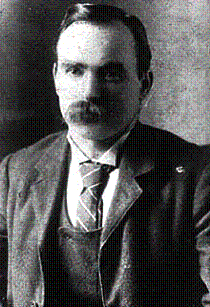
James
Connolly
Red
and Black Publishers, St Petersburg, Florida
Library of Congress Cataloging-in-Publication Data
Connolly, James, 1868-1916.
Socialism and the
Irish Rebellion : writings from James Connolly / James Connolly.
p. cm.
ISBN
978-1-934941-36-2
1. Socialism--Ireland--History--20th century. 2. Labor
movement--Ireland--History--20th century. 3. Ireland--Politics and
government--1901-1910. 4. Ireland--Politics and government--1910-1921.
5. Ireland--History--Easter Rising, 1916. 6. Ireland--Social
conditions--20th century. 7. Working class--Ireland--Political
activity--History--20th century. I. Title.
HX250.3.A6C665
2008
941.5082'1--dc22
2008026347
Red
and Black Publishers, PO Box 7542, St Petersburg, Florida,
33734
Contact
us at: info@RedandBlackPublishers.com
Printed
and manufactured in the United States of America
Contents
Socialism and
Nationalism
5
Socialism and Irish
Nationalism
9
State Monopoly
Versus Socialism
13
Socialism and
Religion: The Known and the Unknowable
17
Socialism And
Political Reformers
21
Physical
Force in Irish Politics
25
The
Economic Basis of Politics: The Stomach, not the Brain
29
Imperialism
and Socialism
33
Dogma
and Food
39
Let
Us Free Ireland!
43
Difficulties
of Socialism
45
Home
Thrusts
49
Parliamentary
Democracy
53
An
Object Lesson
57
Unpatriotic?
61
Declaration
of Principles of the Irish Socialist Federation 65
A
Political Party of the Workers
69
Sinn
Féin And Socialism
73
Industrial
Unionism and Constructive Socialism
81
Sinn
Fein, Socialism and the Nation
87
Ballots,
Bullets, Or —
91
Erin’s
Hope: The End & The Means
97
Industrialism and
the Trade Unions
121
Sweatshops
Behind the Orange Flag
131
Direct
Action in Belfast
137
British
Labour and Irish Politicians
141
Labour
and the Proposed Partition of Ireland
149
Ireland
and Ulster: An Appeal to the Working Class 151
Independent
Labour Party of Ireland: Ireland Upon The Dissecting Table
155
The Problem of Trade Union Organization 159
A Martyr For Conscience Sake
169
The War Upon The German Nation
173
The
Friends of Small Nationalities
179
The Ballot or the
Barricades
183
Rally for Labour
187
Courtsmartial and
Revolution
191
Revolutionary
Unionism and War
195
Insurrectionary
Warfare
201
Liberty and Labour
233
What is a Scab?
237
For the Citizen
Army
241
Conscription
245
The Call To Arms
257
The Irish Flag
261
Socialism
and Nationalism
(1897)
In Ireland at the present time
there are at work a variety of agencies seeking to preserve the national
sentiment in the hearts of the people.
These agencies, whether Irish Language movements, Literary
Societies or Commemoration Committees, are undoubtedly doing a work of lasting
benefit to this country in helping to save from extinction the precious racial
and national history, language and characteristics of our people.
Nevertheless, there is a danger that by too strict an
adherence to their present methods of propaganda, and consequent neglect of
vital living issues, they may only succeed in stereotyping our historical
studies into a worship of the past, or crystallising nationalism into a
tradition – glorious and heroic indeed, but still only a tradition.
Now traditions may, and frequently do, provide materials
for a glorious martyrdom, but can never be strong enough to ride the storm of a
successful revolution.
If the national movement of our day is not merely to
re-enact the old sad tragedies of our past history, it must show itself capable
of rising to the exigencies of the moment.
It must demonstrate to the people of Ireland that our
nationalism is not merely a morbid idealising of the past, but is also capable
of formulating a distinct and definite answer to the problems of the present and
a political and economic creed capable of adjustment to the wants of the future.
This concrete political and social ideal will best be
supplied, I believe, by the frank acceptance on the part of all earnest
nationalists of the Republic as their goal.
Not a Republic, as in France, where a capitalist monarchy
with an elective head parodies the constitutional abortions of England, and in
open alliance with the Muscovite despotism brazenly flaunts its apostasy to the
traditions of the Revolution.
Not a Republic as in the United States, where the power of
the purse has established a new tyranny under the forms of freedom; where, one
hundred years after the feet of the last British red-coat polluted the streets
of Boston, British landlords and financiers impose upon American citizens a
servitude compared with which the tax of pre-Revolution days was a mere trifle.
No! the Republic I would wish our fellow-countrymen to set
before them as their ideal should be of such a character that the mere mention
of its name would at all times serve as a beacon-light to the oppressed of every
land, at all times holding forth promise of freedom and plenteousness as the
reward of their efforts on its behalf.
To the tenant farmer, ground between landlordism on the one
hand and American competition on the other, as between the upper and the nether
millstone; to the wage-workers in the towns, suffering from the exactions of the
slave-driving capitalist to the agricultural labourer, toiling away his life for
a wage barely sufficient to keep body and soul together; in fact to every one of
the toiling millions upon whose misery the outwardly-splendid fabric of our
modern civilisation is reared, the Irish Republic might be made a word to
conjure with – a rallying point for the disaffected, a haven for the
oppressed, a point of departure for the Socialist, enthusiastic in the cause of
human freedom.
This
linking together of our national aspirations with the hopes of the men and women
who have raised the standard of revolt against that system of capitalism and
landlordism, of which the British Empire is the most aggressive type and
resolute defender, should not, in any sense, import an element of discord into
the ranks of earnest nationalists, and would serve to place us in touch with
fresh reservoirs of moral and physical strength sufficient to lift the cause of
Ireland to a more commanding position than it has occupied since the day of
Benburb.
It may be pleaded that the ideal of a Socialist Republic,
implying, as it does, a complete political and economic revolution, would be
sure to alienate all our middle-class and aristocratic supporters, who would
dread the loss of their property and privileges.
What does this objection mean? That we must conciliate the
privileged classes in Ireland!
But you can only disarm their hostility by assuring them
that in a free Ireland their ‘privileges’ will not be interfered with. That
is to say, you must guarantee that when Ireland is free of foreign domination,
the green-coated Irish soldiers will guard the fraudulent gains of capitalist
and landlord from ‘the thin hands of the poor’ just as remorselessly and
just as effectually as the scarlet-coated emissaries of England do today.
On no other basis will the classes unite with you. Do you
expect the masses to fight for this ideal?
When you talk of freeing Ireland, do you only mean the
chemical elements which compose the soil of Ireland? Or is it the Irish people
you mean? If the latter, from what do you propose to free them? From the rule of
England?
But all systems of political administration or governmental
machinery are but the reflex of the economic forms which underlie them.
English rule in England is but the symbol of the fact that
English conquerors in the past forced upon this country a property system
founded upon spoliation, fraud and murder: that, as the present-day exercise of
the ‘rights of property’ so originated involves the continual practice of
legalised spoliation and fraud, English rule is found to be the most suitable
form of government by which the spoliation can be protected, and an English army
the most pliant tool with which to execute judicial murder when the fears of the
propertied classes demand it.
The Socialist who would destroy, root and branch, the whole
brutally materialistic system of civilisation, which like the English language
we have adopted as our own, is, I hold, a far more deadly foe to English rule
and tutelage, than the superficial thinker who imagines it possible to reconcile
Irish freedom with those insidious but disastrous forms of economic subjection
– landlord tyranny, capitalist fraud and unclean usury; baneful fruits of the
Norman Conquest, the unholy trinity, of which Strongbow and Diarmuid
MacMurchadha – Norman thief and Irish traitor – were the fitting precursors
and apostles.
If you remove the English army to-morrow and hoist the
green flag over Dublin Castle, unless you set about the organisation of the
Socialist Republic your efforts would be in vain.
England would still rule you. She would rule you through
her capitalists, through her landlords, through her financiers, through the
whole array of commercial and individualist institutions she has planted in this
country and watered with the tears of our mothers and the blood of our martyrs.
England would still rule you to your ruin, even while your
lips offered hypocritical homage at the shrine of that Freedom whose cause you
had betrayed.
Nationalism without Socialism – without a reorganisation
of society on the basis of a broader and more developed form of that common
property which underlay the social structure of Ancient Erin—is only national
recreancy.
It would be tantamount to a public declaration that our
oppressors had so far succeeded in inoculating us with their perverted
conceptions of justice and morality that we had finally decided to accept those
conceptions as our own, and no longer needed an alien army to force them upon
us.
As a Socialist I am prepared to do all one man can do to
achieve for our motherland her rightful heritage – independence; but if you
ask me to abate one jot or tittle of the claims of social justice, in order to
conciliate the privileged classes, then I must decline.
Such action would be neither honourable nor feasible. Let
us never forget that he never reaches Heaven who marches thither in the company
of the Devil. Let us openly proclaim our faith: the logic of events is with us.
Socialism and Irish Nationalism
(1897)
The public life of Ireland has been
generally so much identified with the struggle for political emancipation, that,
naturally, the economic side of the situation has only received from our
historians and public men a very small amount of attention.
Scientific Socialism is based upon the truth incorporated
in this proposition of Karl Marx, that, “the economic dependence of the
workers on the monopolists of the means of production is the foundation of
slavery in all its forms, the cause of nearly all social misery, modern crime,
mental degradation and political dependence”. Thus this false exaggeration of
purely political forms which has clothed in Ireland the struggle for liberty,
must appear to the Socialist an inexplicable error on the part of a people so
strongly crushed down as the Irish.
But the error is more in appearance than in reality.
The reactionary attitude of our political leaders
notwithstanding, the great mass of the Irish people know full well that if they
had once conquered that political liberty which they struggle for with so much
ardour, it would have to be used as a means of social redemption before their
well-being would be assured.
In spite of occasional exaggeration of its immediate
results one must remember that by striving determinedly, as they have done,
towards this definite political end, the Irish are working on the lines of
conduct laid down by modern Socialism as the indispensable condition of success.
Since the abandonment of the unfortunate insurrectionism of
the early Socialists whose hopes were exclusively concentrated on the eventual
triumph of an uprising and barricade struggle, modern Socialism, relying on the
slower, but surer method of the ballot-box, has directed the attention of its
partisans toward the peaceful conquest of the forces of government in the
interests of the revolutionary ideal.
The advent of Socialism can only take place when the
revolutionary proletariat, in possession of the organized forces of the nation
(the political power of government) will be able to build up a social
organization in conformity with the natural march of industrial development.
On the other hand, non-political co-operative effort must
infallibly succumb in face of the opposition of the privileged classes,
entrenched behind the ramparts of law and monopoly. This is why, even when he is
from the economic point of view intensely conservative, the Irish Nationalist,
even with his false reasoning, is an active agent in social regeneration, in so
far as he seeks to invest with full power over its own destinies a people
actually governed in the interests of a feudal aristocracy.
The section of the Socialist army to which I belong, the
Irish Socialist Republican Party, never seeks to hide its hostility to those
purely bourgeois parties which at present direct Irish politics.
But, in inscribing on our banners an ideal to which they
also give lip-homage, we have no intention of joining in a movement which could
debase the banner of revolutionary Socialism.
The Socialist parties of France oppose the mere Republicans
without ceasing to love the Republic. In the same way the Irish Socialist
Republican Party seeks the independence of the nation, while refusing to conform
to the methods or to employ the arguments of the chauvinist Nationalist.
As Socialists we are not imbued with national or racial
hatred by the remembrance that the political and social order under which we
live was imposed on our fathers at the point of the sword; that during 700 years
Ireland has resisted this unjust foreign domination; that famine, pestilence and
bad government have made this western isle almost a desert and scattered our
exiled fellow-countrymen over the whole face of the globe.
The enunciation of facts such as I have just stated is not
able today to inspire or to direct the political energies of the militant
working class of Ireland; such is not the foundation of our resolve to free
Ireland from the yoke of the British Empire. We recognize rather that during all
these centuries the great mass of the British people had no political existence
whatever; that England was, politically and socially, terrorized by a
numerically small governing class; that the atrocities which have been
perpetrated against Ireland are only imputable to the unscrupulous ambition of
this class, greedy to enrich itself at the expense of defenceless men; that up
to the present generation the great majority of the English people were denied a
deliberate voice in the government of their own country; that it is, therefore,
manifestly unjust to charge the English people with the past crimes of their
Government; and that at the worst we can but charge them with a criminal apathy
in submitting to slavery and allowing themselves to be made an instrument of
coercion for the enslavement of others. An accusation as applicable to the
present as to the past.
But whilst refusing to base our political action on
hereditary national antipathy, and wishing rather comradeship with the English
workers than to regard them with hatred, we desire with our precursors the
United Irishmen of 1798 that our animosities be buried with the bones of our
ancestors – there is not a party in Ireland which accentuates more as a vital
principle of its political faith the need of separating Ireland from England and
of making it absolutely independent. In the eyes of the ignorant and of the
unreflecting this appears an inconsistency, but I am persuaded that our
Socialist brothers in France will immediately recognize the justice of the
reasoning upon which such a policy is based.
1. We hold “the economic emancipation of the worker
requires the conversion of the means of production into the common property of
Society”. Translated into the current language and practice of actual politics
this teaches that the necessary road to be travelled towards the establishment
of Socialism requires the transference of the means of production from the hands
of private owners to those of public bodies directly responsible to the entire
community.
2. Socialism seeks then in the interest of the democracy to
strengthen popular action on all public bodies.
3. Representative bodies in Ireland would express more
directly the will of the Irish people than when those bodies reside in England.
An Irish Republic would then be the natural depository of
popular power; the weapon of popular emancipation, the only power which would
show in the full light of day all these class antagonisms and lines of economic
demarcation now obscured by the mists of bourgeois patriotism.
In that there is not a trace of chauvinism. We desire to
preserve with the English people the same political relations as with the people
of France, or Germany, or of any other country; the greatest possible
friendship, but also the strictest independence. Brothers, but not bedfellows.
Thus, inspired by another ideal, conducted by reason not by tradition, following
a different course, the Socialist Republican Party of Ireland arrives at the
same conclusion as the most irreconcilable Nationalist. The governmental power
of England over us must be destroyed; the bonds which bind us to her must be
broken. Having learned from history that all bourgeois movements end in
compromise, that the bourgeois revolutionists of today become the conservatives
of tomorrow, the Irish Socialists refuse to deny or to lose their identity with
those who only half understand the problem of liberty. They seek only the
alliance and the friendship of those hearts who, loving liberty for its own
sake, are not afraid to follow its banner when it is uplifted by the hands of
the working class who have most need of it. Their friends are those who would
not hesitate to follow that standard of liberty, to consecrate their lives in
its service even should it lead to the terrible arbitration of the sword.