This New Ocean
A History of Project Mercury
by
Loyd
S. Swenson Jr.
James
M. Grimwood
Charles
C. Alexander
Red and Black Publishers, St Petersburg, Florida
Library
of Congress Cataloging-in-Publication Data
Swenson, Loyd S.
This new ocean : a history of Project Mercury / by Loyd S. Swenson Jr.,
James M. Grimwood, Charles C. Alexander.
p. cm.
"Originally published by NASA, 1966."
ISBN 978-1-934941-87-4
1. Project Mercury (U.S.)--History.
I. Grimwood, James M. II. Alexander, Charles C. III. Title.
TL789.8.U6M547 2010
629.45'40973--dc22
2010011558
Red and Black Publishers, PO
Box 7542, St Petersburg, Florida, 33734
Contact us at: info@RedandBlackPublishers.com
Printed and manufactured in the United States of America
Contents
Part 1 – Research
5
Chapter 1—The
Lure, the lock, the Key (to 1958)
5
Chapter
2—Exploring the Human Factor (1948—1958) 28
Chapter
3—Aeronautics to Astronautics: NACA Research (1952—1957)
47
Chapter 4—From
NACA to NASA (November 1957—September 1958) 65
Part 2 –
Development
94
Chapter
5—Specifications for a Manned Satellite (October—December 1958)
94
Chapter 6—From
Design into Development (January—June 1959) 118
Chapter
7—Man-Rating the Machines (July—December 1959) 146
Chapter
8—Machine-Rating the Men (January—June 1960) 195
Chapter 9—From
Development into Qualification: Flight Tests (July—December
1960)
231
Chapter 10—Tests
Versus Time in the Race for Space (January—April 1961)
280
Part 3 –
Operations
322
Chapter 11—Suborbital
Flights into Space
322
Chapter 12—Final
Rehearsal
357
Chapter
13—Mercury Mission Accomplished
383
Chapter 14—Climax
of Project Mercury
426
Epilogue 464
Part 1—Research
Chapter 1. The Lure, the Lock, the Key (To 1958)
The yearning of
men to escape the confines of their Earth and to travel to the heavens is older
than the history of mankind itself. Religion, mythology, and literature reaching
back thousands of years are sprinkled with references to magic carpets, flying
horses, flaming aerial chariots, and winged gods. Although “science fiction”
is a descriptive term of recent vintage, the fictional literature of space
travel dates at least from the second century A.D. Around the year 160 the Greek
savant Lucian of Samosata wrote satirically about an imaginary journey to the
Moon, “a great countrie in the aire, like to a shining island,” as
Elizabethan scholars translated his description 1,500 years later. Carried to
the Moon by a giant waterspout, Menippus, Lucian’s hero, returns to Earth in
an equally distinctive manner: The angry gods simply have Mercury take hold of
his right ear and deposit him on the ground. Lucian established a tradition of
space-travel fiction, and generations of later storytellers spawned numerous
fantasies in which by some miraculous means—such as a flight of wild lunar
swans in a seventeenth-century tale by Francis Godwin or a cannon shot in Jules
Verne’s classic account of a Moon voyage (1865-1870)—earthlings are
transported beyond the confines of their world and into space.
But
apparently the first suggestion, fictional or otherwise, for an artificial
manned satellite of Earth is to be found in a short novel called “The Brick
Moon,” written in 1869 by the American Edward Everett Hale and originally
serialized in the Atlantic Monthly. Although, like most of his
contemporaries, Hale had only a vague notion of where Earth’s atmosphere ended
and where space began, he did realize that somewhere the “aire” became the
“aether,” and he also understood the mechanics of putting a satellite into
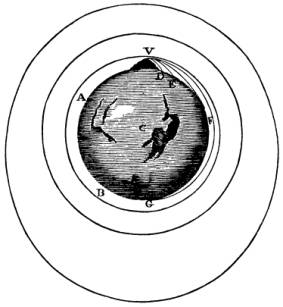
an Earth orbit: “If from the surface of the earth, by a gigantic peashooter,
you could shoot a pea upward . . . if you drove it so fast and far that when its
power of ascent was exhausted, and it should fall, it should clear the earth . .
. if you had given it sufficient power to get it half way round the earth
without touching, that pea would clear the earth forever. It would continue to
rotate . . . with the impulse with which it had first cleared our atmosphere and
attraction.”
In
Hale’s story a group of industrious New Englanders construct a
200-foot-diameter brick sphere, which, carrying 37 people, is prematurely hurled
into an orbit 4,000 miles from Earth by two huge flywheels. Less than a hundred
years later, Hale’s own country would undertake a more modest and more
practicable scheme for a manned satellite in Project Mercury.
The
action of centripetal forces as advanced by Isaac Newton: “That by means of
centripetal forces the planets may be retained in certain orbits, we may easily
understand, if we consider the motions of projectiles; for a stone that is
projected is by the pressure of its own weight forces out of the rectlinear
path, which by the initial projection alone it should have pursued, and made to
describe a curved line in the air; and through that crooked way is at last
brought down to the ground; and the greater the velocity is with which it is
projected, the farther it goes before it falls to the earth. We may therefore
suppose the velocity to be so increased, that it would describe an arc of 1, 2,
5, 10, 100, 1,000 miles before it arrived at earth, till at last, exceeding the
limits of the earth, it should pass into space without touching it.”
Centuries
before Hale wrote about an orbiting manned sphere, Nicolaus Copernicus, Johannes
Kepler, Galileo Galilei, and other astronomers had helped put the solar system
in order, with the Sun in the center and the various planets, spherical and of
different sizes, orbiting elliptically around it. Isaac Newton had established
the basic principles of gravitation and mechanics governing reaction propulsion
and spatial navigation.
Thus it was possible for Hale and his fellow–fictionists to think at least
half seriously about, and to describe in fairly accurate detail, such adventures
as orbiting Earth and its Moon and voyaging to Venus.
Most
flight enthusiasts in the nineteenth century, however, were absorbed with the
problems of flight within the atmosphere, with conveyance from one place to
another on Earth. This preoccupation with atmospheric transport, which would
continue until the mid-twentieth century, in many ways retarded interest in
rocketry and space travel. But the development and refinement of aeronautics in
the twentieth century was both a product of and a stimulant to man’s
determination to fly ever higher and faster, to travel as far from his Earth as
he could. Atmospheric flight, in terms of both motivation and technology, was a
necessary prelude to the exploration of near and outer space. In a sense,
therefore, man’s journey along the highway to space, leading to such
astronautical achievements as Project Mercury, began in the dense forest of his
atmosphere, with feats in aeronautics.
Conquest
of the Air
Man
first ventured aloft in balloons in the 1780s, and in the next century gliders
also bore human passengers on the air. By 1900 a host of theoreticians and
inventors in Europe and the United States were steadily expanding their
knowledge and capability beyond the flying of balloons and gliders and into the
complexities of machineborne flight. The essentials of the airplane—wings,
rudders, engine, and propeller—already were well known, but what had not been
done was to balance and steer a heavier-than-air flying machine.
On
December 8, 1903, Samuel Pierpont Langley, a renowned astrophysicist and
Secretary of the Smithsonian Institution, tried for the second time to fly his
manned “aerodrome,” a glider fitted with a small internal combustion engine,
by catapulting it from a houseboat on the Potomac River. The much-publicized
experiment, financed largely by the United States War Department, ended in
failure when the machine plunged, with pilot-engineer Charles M. Manley, into
the cold water. The undeserved wave of ridicule and charges of waste that
followed Langley’s failure obscured what happened nine days later at Kitty
Hawk, North Carolina. There two erstwhile bicycle mechanics from Dayton, Ohio,
Wilbur and Orville Wright, carried out “the first [flight] in the history of
the world in which a machine carrying a man had raised itself by its own power
into the air in full flight, had sailed forward without reduction of speed, and
had finally landed at a point as high as that from which it started.” Although
few people realized it at the time, practicable heavier-than-air flight had
become a reality.
The
United States Army purchased the first military airplane, a Wright Flyer, in
1908. But when Europe plunged into general war in 1914, competitive
nationalism—drawing on the talents of scientists like Ernst Mach in Vienna,
Ludwig Prandtl in Germany, and Osborne Reynolds in Great Britain, and of
inventors like the Frenchmen Louis Bleriot and Gabriel Voisin—had accelerated
European flight technology well beyond that of the United States. In 1915, after
several years of agitation for a Government-financed “national aeronautical
laboratory” like those already set up in the major European countries,
Congress took the first step to regain the leadership in aeronautics that the
United States had lost after 1908. By an amendment attached to a naval
appropriation bill, Congress established an Advisory Committee for Aeronautics
“to supervise and direct the scientific study of the problems of flight, with
a view to their practical solution.” President Woodrow Wilson, who at first
had feared that the creation of such an organization might reflect on official
American neutrality, appointed the stipulated 12 unsalaried members to the
“Main Committee,” as the policymaking body of the new organization came to
be called. At its first meeting, the Main Committee changed the name of the
organization to National Advisory Committee for Aeronautics, and shortly
“NACA” began making surveys of the state of aeronautical research and
facilities in the country. During the First World War it aided significantly in
the formulation of national policy on such critical problems as the
cross-licensing of patents and aircraft production. NACA did not have its own
research facilities, however, until 1920, when it opened the Langley Memorial
Aeronautical Laboratory, named after the “aerodrome” pioneer, at Langley
Field, Virginia.
In
the 1920s and 1930s aeronautical science and aviation technology continued to
advance, as the various cross-country flights, around-the-world flights, and the
most celebrated of all aerial voyages, Charles A. Lindbergh’s nonstop flight
in 1927 from New York to Paris, demonstrated. During these decades NACA brought
the United States worldwide leadership in aeronautical science. Concentrating
its research in aerodynamics and aerodynamic loads, with lesser attention to
structural materials and powerplants, NACA worked closely with the Army and Navy
laboratories, with the National Bureau of Standards, and with the young and
struggling aircraft industry to enlarge the theory and technology of flight. The
reputation for originality and thorough research that NACA quietly built in the
interwar period would continue to grow until 1958, when the organization would
metamorphose into a glamorous new space agency, the likes of which might have
frightened the early NACA stalwarts.
Over
the years NACA acquired a highly competent staff of “research engineers” and
technicians at its Langley laboratory. Young aeronautical and
mechanical engineers just leaving college were drawn to NACA by the intellectual
independence characterizing the agency, by the opportunity to do important work
and see their names on regularly published technical papers, and by the superior
wind tunnels and other research equipment increasingly available at the Virginia
site. NACA experimenters made discoveries leading to such major innovations in
aircraft design as the smooth cowling for radial engines, wing fillets to cut
down on wing-fuselage interference, engine nacelles mounted in the wings of
multiengine craft, and retractable landing gear. This and other research led to
the continual reduction of aerodynamic drag on aircraft shapes and consequent
increases in speed and overall performance.
The
steady improvement of aircraft design and performance benefited commercial as
well as military aviation. Airlines for passenger, mail, and freight transport,
established in the previous decade both in the United States and Europe,
expanded rapidly in the depression years of the thirties. In the year 1937 more
than a million passengers flew on airlines in the United States alone. At
the same time, advances in speed, altitude, and distance, together with numerous
innovations in flight engineering and instrumentation, presaged the arrival of
the airplane as a decisive military weapon.
Yet
NACA remained small and inconspicuous; as late as the summer of 1939 its total
complement was 523 people, of whom only 278 were engaged in research activities.
Its budget for that fiscal year was $4,600,000. The prevailing mood
of the American public throughout the thirties was reflected in the neutrality
legislation passed in the last half of the decade, in niggardly defense
appropriations, and in the preoccupation of the Roosevelt administration with
the domestic aspects of the Great Depression. Without greatly increased
appropriations from Congress, the military was held back in its efforts to
acquire more and better aerial weapons. Without a military market for its
products, the American aircraft industry proceeded cautiously and slowly in the
design and manufacture of airframes and powerplants. And in the face of the
restricted needs of industry and the armed services and severely limited
appropriations, NACA kept its efforts focused where it could acquire the
greatest quantity of knowledge for the smallest expenditure of funds and
manpower—in aerodynamics.
As
Europe moved nearer to war, however, the Roosevelt administration, Congress, and
the public at large showed more interest in an expanded military establishment,
including military aviation. Leading figures like Lindbergh and Vannevar Bush,
president of the Carnegie Institution and chairman of the Main Committee, warned
of the remarkable gains in aviation being made in other countries, especially in
Nazi Germany. While the United States may have retained its aerodynamics
research lead, the Germans, drawing, in part from the published findings of NACA,
by 1939 had temporarily outstripped this country in aeronautical development.
After
the outbreak of war in Europe, NACA eventually secured authorization and funding
to increase its program across the board, including a much enlarged effort in
propulsion and structural materials research. A new aeronautical laboratory,
named after physicist Joseph S. Ames of Johns Hopkins University, former
chairman of the Main Committee, was constructed beginning in 1940 on land
adjacent to the Navy installation at Moffett Field, California, 40 miles south
of San Francisco. The next year, on a site next to the municipal airport at
Cleveland, NACA broke ground for still another laboratory, to be devoted
primarily to engine research. In later years the Cleveland facility would be
named the Lewis Flight Propulsion Laboratory, after George W. Lewis, for 28
years NACA’s Director of Research.
Some
nine months before Pearl Harbor, Chairman Bush of NACA appointed a Special
Committee on Jet Propulsion, headed by former Main Committeeman William F.
Durand of Stanford University, and including such leaders in aeronautical
science as Theodore von Kármán of the California Institute of Technology and
Hugh L. Dryden of the National Bureau of Standards. Until then NACA, the
military services, and the aircraft industry had given little attention to jet
propulsion. There had been little active disagreement with the conclusion
reached in 1923 by Edgar Buckingham of the Bureau of Standards: “Propulsion by
the reaction of a simple jet cannot compete, in any respect, with air screw
propulsion at such flying speeds as are now in prospect.” By 1941, however,
Germany had flown turbojets, and her researchers were working intensively on the
development of an operational jet-propelled interceptor. In Britain the
propulsion scientist Frank Whittle had designed and built a gas-turbine engine
and had flown a turbojet-powered aircraft.
Faced
with the prospect of European-developed aircraft that could reach flight regimes
in excess of 400 miles per hour and operational altitudes of about 40,000 feet,
NACA gradually authorized more and more research on jet powerplants for the Army
Air Forces and the Navy. Most of the NACA research effort during the war,
however, went to “quick fixes,” improving or “cleaning up” military
aircraft already produced by aircraft companies, rather than to the more
fundamental problems of aircraft design, construction, and propulsion. So,
understandably and predictably, during the Second World War, Germany was first
to put into operation military aircraft driven by jet powerplants, as well as
rocket-powered interceptors that could fly at 590 miles per hour and climb to
40,000 feet in two and a half minutes. The German jets and rocket planes came
into the war too late to have any effect on its outcome, but the new aircraft
caused consternation among American aeronautical scientists and military
planners.
The
Second World War saw, in the words of NACA Chairman Jerome C. Hunsaker, “the
end to the development of the airplane as conceived by Wilbur and Orville
Wright.” Propeller-driven aircraft advanced far beyond their original
reconnaissance and tactical uses and became integral instruments of strategic
warfare. The development of the atomic bomb meant a multifold increase in the
firepower of aircraft, but well before the single B-29 dropped the single
five-ton bomb on Hiroshima, long-range bomber fleets carrying conventional TNT
explosives and incendiaries had radically altered the nature of war.
The
frantic race in military technology developing in the postwar years between the
United States and the Soviet Union produced a remarkable acceleration in the
evolution of the airplane. Jet-propelled interceptors, increasingly rakish in
appearance by comparison with their staid propeller-driven ancestors, flew ever
faster, higher, and farther. Following the recommendations of a series of
blue-ribbon scientific advisory groups, the Defense Department and the newly
independent Air Force made the Strategic Air Command, with its thousands of huge
manned bombers, the first line of American defense in the late forties and early
fifties. To many people the intercontinental bomber, carrying fission and (after
1954) hydrogen-fusion weapons, capable of circumnavigating the globe nonstop
with mid-air refueling, looked like the “ultimate weapon” men had sought
since the beginning of human conflict.
Working
under the incessant demands of the cold-war years, NACA continued to pioneer in
applied aeronautical research. By 1946 the NACA staff had grown to about 6,800,
its annual budget was in the vicinity of $40 million, and its facilities were
valued at more than $200 million. Although Chairman Hunsaker and others on the
Main Committee felt that NACA’s principal mission should be inquiry into the
fundamentals of aeronautics, the military services and the aircraft industry
continued to rely on NACA as a problem-solving agency. The pressure for “quick
fixes” persisted as the Korean War intensified requirements for work on
specific aircraft problems.
The
outstanding general impediment to aeronautical progress, however, continued to
be the so-called “sonic barrier”, a region near the speed of sound
(approximately 750 miles per hour at sea level, 660 miles per hour above 40,000
feet) wherein an aircraft encounters compressibility phenomena in fluid
dynamics, or the “piling up” of air molecules. A serious technical obstacle
to high-speed research in the postwar years was the choking effect experienced
in wind tunnels during attempts to simulate flight conditions in the transonic
range (600-800 miles per hour). A wind tunnel constructed at Langley employing
the slotted-throat principle to overcome the choking phenomenon did not begin
operation until 1951, and a series of NACA and Air Force supersonic tunnels,
authorized by Congress under the Unitary Plan Act of 1949, was not completed
until the mid–fifties. NACA investigators had to use other methods for
extensive transsonic research. One was a falling-body technique, in which
airplane models equipped with radio-telemetry apparatus were dropped from
bombers at high altitudes. Another was the firing of small solid–propellant
rockets to gather data on various aerodynamic shapes accelerated past mach 1,
the speed of sound. Many of these tests supported military missile studies. The
rocket firings were carried out at the Pilotless Aircraft Research Station, a
facility set up by the Langley laboratory on Wallops Island, off the Virginia
coast, in the spring of 1945. The Pilotless Aircraft Research Division at
Langley, until the early fifties headed by Robert R. Gilruth, conducted the NACA
program of aerodynamic research with rocket-launched models.
The
most celebrated part of the postwar aeronautical research effort in the United
States, however, was the NACA-military work with rocket-propelled aircraft. In
1943, Langley aerodynamicist John Stack and Robert J. Woods of the Bell Aircraft
Corporation, realizing that propeller-driven aircraft had about reached their
performance limits, suggested the development of a special airplane for research
in the problems of transonic and supersonic flight. The next year, the Army Air
Forces, the Navy, and NACA inaugurated a program for the construction and
operation of such an airplane, to be propelled by a liquid-fueled rocket engine.
Built by Bell and eventually known as the X-1, the plane was powered by a
6,000-pound-thrust rocket burning liquid oxygen and a mixture of alcohol and
distilled water. On October 14, 1947, above Edwards Air Force Base in southern
California, the X-1 dropped from the underside of its B-29 carrier plane at
35,000 feet and began climbing. A few seconds later the pilot of the small,
bullet-shaped craft, Air Force Captain Charles E. Yeager, became the first man
officially to fly faster than the speed of sound in level or climbing flight.
The
X-1 was the first of a line of generally successful rocket research airplanes.
In November 1953 the Navy’s D-558-II, built by the Douglas Aircraft Company
and piloted by A. Scott Crossfield of NACA, broke mach 2, twice sonic speed; but
this record stood only until the next month, when Yeager flew the new Bell X-1A
to mach 2.5, or approximately 1,612 miles per hour. The following summer Major
Arthur Murray of the Air Force pushed the X-1A to a new altitude record of
90,000 feet above the Mojave Desert test complex consisting of Edwards Air Force
Base and NACA’s High Speed Flight Station. These spectacular research flights,
besides banishing the myth that aircraft could not fly past the “sonic
barrier,” affected the design and performance of tactical military aircraft.
In the early fifties, the Air Force and the aircraft industry, profiting
from the mountain of NACA research data, were preparing to inaugurate the new
“century series” of supersonic jet interceptors. And
representatives of NACA, the Air Force, and the Navy Bureau of Aeronautics
already were planning a new experimental rocket plane, the X-15, to employ the
most powerful rocket aircraft motor ever developed and to fly to an altitude of
50 miles, the very edge of space.
Thus
less than a decade after the end of the Second World War,
airplanes—jet-powered and rocket-propelled had—virtually finished exploring
the sensible atmosphere, the region below 80,000 or 90,000 feet. Much work
remained for aeronautical scientists and engineers in such areas as airflow,
turbulence, engines, and fuels, but researchers in NACA, the military, and the
aircraft industry approached the thorniest problems in aeronautics with a
confidence grounded in 50 years of progress. Man’s facility in atmospheric
flight and his adjustment to the airplane seemed complete. Pilots had mastered
some of the most complex moving machines ever contrived, and passengers sat
comfortably and safely in pressurized cabins on high-altitude airliners
featuring an unprecedented combination of speed and luxury. It appeared that man
at last had accomplished what the ancients had dreamed of—conquest of the air.
The
Highway to Space
Space
flight, however, was something else. While in one sense atmospheric flight was
the first step toward space flight, extra-atmospheric transport involves much
more than a logical extension of aviation technology. The airplane, powered
either by a reciprocating or a jet engine, is a creature and a captive of the
atmosphere, because either powerplant depends on air—more properly,
oxygen—for its operation, and in space there is no air. But the rocket, unlike
the gas turbine, pulsejet, ramjet, or piston engine, needs no air. It carries
everything needed for propulsion within itself—its own fuel and some form of
oxidizer, commonly liquid oxygen, to burn the fuel. So the rocket engine
operates independently of its environment; in fact, its efficiency increases as
it climbs away from the frictional density of the lower atmosphere to the thin
air of the stratosphere and into the airlessness of space.
Yet
even the rocket research airplanes were a long way from spacecraft. Although
some of these vehicles provided data on the use of reaction controls for
steering in the near vacuum of the upper atmosphere, they were designed to
produce considerable aerodynamic lift for control within the lower atmosphere;
and, in terms of the mass to be accelerated, their powerplants burned too
briefly and produced too little thrust to counterbalance the oppressive force of
gravity. Fulfillment of the age-old desire to travel to the heavens, even
realization of Hale’s nineteenth-century concept of a manned sphere circling
Earth in lower space, would have to await the development of rockets big enough
to boost thousands of pounds and to break the lock of gravity.
Although
black-powder rockets, invented by the Chinese, had been used for centuries for
festive and military purposes, not until the late nineteenth and early twentieth
centuries did imaginative individuals in various parts of the world begin
seriously to consider the liquid-fueled rocket as a vehicle for spatial
conveyance. The history of liquid-fueled rocketry, and thus of manned space
flight, is closely linked to the pioneering careers of three men—the Russian
Konstantin Eduardovich Tsiolkovsky (1857-1935), the American Robert Hutchings
Goddard (1882-1945), and the German-Romanian Hermann Oberth (1894-).
Tsiolkovsky,
for most of his life an obscure teacher of mathematics, authored a series of
remarkable technical essays on such subjects as reaction propulsion with
liquid-propellant rockets, attainable velocities, fuel compositions, and oxygen
supply and air purification for space travelers. He also wrote what apparently
was the first technical discussion of an artificial Earth satellite. Although
virtually unknown in the West at the time of his death, in 1935, Tsiolkovsky was
honored by the Soviets and had helped establish a long Russian tradition of
astronautics. This tradition helps to account for the U.S.S.R.’s advances with
rocket-assisted airplane takeoffs and small meteorological rockets of the 1930s
and her space achievements of the 1950s and 1960s.
In
terms of experimentation, Goddard, professor of physics at Clark University, was
by far the most important of the rocket pioneers. As early as 1914 he secured a
patent for a small liquid-fueled rocket engine. Six years later he published a
highly technical paper on the potential uses of a rocket with such an engine for
studying atmospheric conditions at altitudes from 20 to 50 miles. Toward the end
of the paper he mentioned the possibility of firing a rocket containing a powder
charge that could be exploded on the Moon. “It remains only to perform certain
necessary preliminary experiments before an apparatus can be constructed that
will carry recording instruments to any desired altitude,” he concluded.
Goddard’s
life for the next 20 years was devoted to making those “necessary preliminary
experiments.” Working in the 1920s in Massachusetts with financial support
from various sources and in the New Mexico desert with Guggenheim Foundation
funds during the succeeding decade, Goddard compiled an amazing list of
“firsts” in rocketry. Among other things, he carried out the first recorded
launching of a liquid-propellant rocket (March 16, 1926), adapted the gyroscope
to guide rockets, installed movable deflector vanes in a rocket exhaust nozzle
for stability and steering, patented a design for a multistage rocket, developed
fuel pumps for liquid-rocket motors, experimented with self-cooling and
variable-thrust motors, and developed automatically deployed parachutes for
recovering his instrumented rockets. Finally, he was the first of the early
rocket enthusiasts to go beyond theory and design into the realm of “systems
engineering”—the complex and hand-dirtying business of making airframes,
fuel pumps, valves, and guidance devices compatible, and of doing all the other
things necessary to make a rocket fly. Goddard put rocket theory into practice,
as his 214 patents attest.
Goddard
clearly deserves the fame that has attached to his name in recent years, but in
many ways he was more inventor than scientist. He deliberately worked in lonely
obscurity, jealously patented virtually all of his innovations, and usually
refused to share his findings with others. Consequently his work was not as
valuable as it might have been to such of his contemporaries as the young rocket
buffs who formed the American Rocket Society in the early thirties and vainly
sought his counsel.
Goddard’s
disdain for team research prompted his refusal to work with the California
Institute of Technology Rocket Research Project, instigated in 1936 by the
renowned von Kármán, then director of the Guggenheim Aeronautical Laboratory
at CalTech. The CalTech group undertook research in the fundamentals of
high-altitude sounding rockets, including thermodynamics, the principles of
reaction, fuels, thrust measurements, and nozzle shapes. Beginning in 1939 the
Guggenheim Laboratory, under the first Federal contract for rocket research,
carried out studies and experiments for the Army Air Forces, especially on
rocket-assisted takeoffs for aircraft. These takeoff rockets were called JATO
(for “Jet-Assisted Take-Off”) units, because, as one of the CalTech
scientists recalled, “the word ‘rocket’ was of such bad repute that [we]
felt it advisable to drop the use of the word. It did not return to our
vocabulary until several years later ....” In 1944, with the
Guggenheim Laboratory working intently on Army and Navy contracts for JATO units
and small bombardment rockets, the Rocket Research Project was reorganized as
the Jet Propulsion Laboratory.
In
the 1920s and 1930s interest in rocketry and space exploration became firmly
rooted in Europe, although the rapid expansion of aviation technology occupied
the attention of most flight-minded Europeans. Societies of rocket theorists and
experimenters, mostly privately sponsored, were established in several European
countries. The most important of these groups was the Society for Space Travel (Verein
für Raumschiffahrt), founded in Germany but having members in other
countries. The “VfR,” as its founders called it, gained much of its
impetus from the writings of Oberth, who in 1923, as a young mathematician,
published his classic treatise on space travel, The Rocket into
Interplanetary Space. A substantial portion of this small book was devoted
to a detailed description of the mechanics of putting into orbit a satellite of
Earth.
Spurred
by Oberth’s theoretical arguments, the Germans in the VfR in the early
thirties conducted numerous static firings of rocket engines and launched a
number of small rockets. Meanwhile the German Army, on the assumption that
rocketry could become an extension of long-range artillery and because the
construction of rockets was not prohibited by the Treaty of Versailles, had
inaugurated a modest rocket development program in 1931, employing several of
the VfR members. One of these was a 21-year-old engineer named Wernher
von Braun, who later became the civilian head of the army’s rocket research
group. In 1933 the new Nazi regime placed all rocket experimentation, including
that being done by the rest of the VfR, under strict government control.
The
story of German achievements in military rocketry during the late thirties and
early forties at Peenemuende, the vast military research installation on the
Baltic Sea, is well known. Knowing Goddard’s work only through his published
findings, the German experimenters contrived and elaborated on nearly all of the
American’s patented technical innovations, including gyroscopic controls,
parachutes for rocket recovery, and movable deflector vanes in the exhaust. The
rocket specialists at Peenemuende were trying to create the first large,
long-range military rocket. By 1943, after numerous frustrations, they had their
“big rocket,” 46 feet long by 11½ feet in diameter, weighing 34,000 pounds
when fueled, and producing 69,100 pounds of thrust from a single engine
consuming liquid oxygen and a mixture of alcohol and water. Called
“Assembly-4” (A-4) by the Peenemuende group, the rocket had a range of
nearly 200 miles and a maximum velocity of about 3,500 miles per hour, and was
controlled by its gyroscope and exhaust deflector vanes, sometimes supplemented
by radio control.
When Major General Walter Dornberger, commander of the army works at Peenemuende,
pronounced the A-4 operational in 1944, Joseph Goebbels’ propaganda machine
christened it Vergeltungswaffe zwei (Vengeance Weapon No. 2), or
“V-2.” But for the space-travel devotees at Peenemuende the rocket remained
the A-4, a step in the climb toward space.
Although
the total military effect of the 3,745 V-2s fired at targets on the Continent
and in England was slight, this supersonic ballistic missile threw a long shadow
over the future of human society. As the Western Allies and the Soviets swept
into Germany, they both sought to confiscate the elements of the German rocket
program in the form of records, hardware, and people. Peenemuende was within the
Russian zone of occupation, but before the arrival of the Soviet forces von
Braun and most of the other engineers and technicians fled westward with a
portion of their technical data. The Americans also captured the underground V-2
factory in the Harz Mountains; 100 partially assembled V-2s were quickly
dismantled and sent to the United States. Ultimately von Braun and about 125
other German rocket specialists reached this country under “Project
Paperclip,” carried out by the United States Army.
The
Soviets captured no more than a handful of top Peenemuende engineers and
administrators. “This is absolutely intolerable,” protested Josef Stalin to
Lieutenant Colonel G. A. Tokaty, one of his rocket experts. “We defeated the
Nazi armies; we occupied Berlin and Peenemuende; but the Americans got the
rocket engineers.” The Russians did obtain a windfall, however, in the form of
hundreds of technicians and rank-and-file engineers, the Peenemuende
laboratories and assembly plant, and lists of component suppliers. From those
suppliers located in the Russian zone the Soviets secured enough parts to
reactivate the manufacture of V-2s. The captured technicians and engineers were
transported to the Soviet Union, where the Russian rocket specialists
systematically drained them of the technical information they possessed but did
not permit them to participate directly in the burgeoning postwar Soviet rocket
development program.
During
the war Russian rocket developers, like their American counterparts, had
concentrated on JATO and small bombardment rockets. “Backward though they were
often said to be in matters of technology,” observed James Phinney Baxter
right after the war, “it was the Russians who in 1941 first employed rockets
on a major scale. They achieved a notable success, and made more use of the
rocket as a ground-to-ground weapon than any other combatant.” In the postwar
years the Soviets quickly turned to the development of large liquid-propellant
rockets. Lacking an armada of intercontinental bombers carrying atomic warheads,
such as the United States possessed, they envisioned “trans-Atlantic
rockets” as “an effective straightjacket for that noisy shopkeeper Harry
Truman,” to use Stalin’s words. Consequently the U.S.S.R. undertook to build
a long-range military rocket years before nuclear weaponry actually became
practicable for rockets; indeed, even before the Soviets had perfected an atomic
device for delivery by aircraft.
The
U.S.S.R. began exploration of the upper atmosphere with captured V-2s in the
fall of 1947. Within two years, however, Soviet production was underway on a
single-stage rocket called the T-1, an improved version of the V-2. The first
rocket divisions of the Soviet Armed Forces were instituted in 1950 or 1951.
Probably in 1954, development work began on a multistage rocket to be used both
as a weapon and as a vehicle for space exploration. And in the spring of 1956
Communist Party Chairman Nikita Khrushchev warned that “soon” Russian
rockets carrying thermonuclear warheads would be able to hit any target on
Earth.
Postwar
American Rocketry
Meanwhile
the United States, convinced of the long-term superiority of her
intercontinental bombers, pursued national security by means of airpower. The
extremely heavy weight of atomic warheads meant that they would have to be
delivered by large bombers, or by a much bigger rocket than anyone in the
military was willing to ask Congress to fund. Despite the early postwar warnings
of General Henry H. Arnold and others, for whom the V-2 experience was
prophetic, the Truman administration and Congress listened to conservative
military men and civilian scientists who felt that until at least 1965 manned
bombers, supplemented by air-breathing guided missiles evolving from the German
V-1, should be the principal American “deterrent force.” Just after the war
former NACA Chairman Bush, then Director of the Office of Scientific Research
and Development, had expressed the prevailing mood in a much-quoted (and perhaps
much-regretted) piece of testimony before a Congressional committee: “There
has been a great deal said about a 3,000-mile high-angle rocket. In my opinion,
such a thing is impossible today and will be impossible for many years .... I
wish the American public would leave that out of their thinking.”
The
United States developed guided missiles for air-to-air, air-to-surface, and
surface-to-air interception uses and as tactical surface-to-surface weapons.
Rocket motors, using both liquid and solid fuels, gradually replaced jet
propulsion systems, but short-range defensive missiles remained advanced enough
for most tastes until the late 1950s.
As
for scientific research in the upper atmosphere, the backlog of V-2s put
together by the United States Army from captured components would do in the
early postwar years. From April 1946 to October 1951, 66 V-2s were fired at the
Army’s White Sands Proving Grounds, New Mexico, in the most extensive rocket
and upper-atmospheric research program to that time. The Army Ordnance
Department, the Air Force, the Air Force Cambridge Research Center, the General
Electric Company, various scientific institutions, universities, and government
agencies, and the Naval Research Laboratory participated in the White Sands V-2
program. Virtually all the rockets were heavily instrumented, and many of them
carried plant life and animals. V-2s carried monkeys aloft on four occasions;
telemetry data transmitted from the rockets showed no ill effects on the
primates until each was killed in the crash. The most memorable launching at
White Sands, however, came on February 24, 1949, when a V-2 boosted a WAC
Corporal rocket developed by the Jet Propulsion Laboratory 244 miles into space
and to a speed of 5,510 miles per hour, the greatest altitude and velocity yet
attained by a man-made object. A year and a half later, a V-2—WAC Corporal
combination rose from Cape Canaveral, Florida, in the first launch at the Air
Force’s newly activated Long Range Proving Ground.
By
the late forties, with the supply of V-2s rapidly disappearing, work had begun
on more reliable and efficient research rockets. The most durable of these
indigenous projectiles proved to be the Aerobee, designed as a sounding rocket
by the Applied Physics Laboratory of Johns Hopkins University and financed by
the Office of Naval Research. With a peak altitude of about 80 miles, the
Aerobee served as a reliable tool for upper-atmospheric research until the late
1950s. The Naval Research Laboratory designed the Viking, a long, slim
high-altitude sounding rocket, manufactured by the Glenn L. Martin Company of
Baltimore. In August 1951 the Viking bettered its own altitude record for a
single-stage rocket, reaching 136 miles from a White Sands launch. In the
fifties, instrumentation carried in Aerobees and Vikings extended knowledge of
the atmosphere to 150 miles, provided photographs of Earth’s curvature and
cloud cover, and gave some information on the Sun and cosmic radiation.
In
1955 the Viking was chosen as the first stage and an improved Aerobee as the
second stage for a new, three-stage rocket to be used in Project Vanguard, which
was to orbit an instrumented research satellite as part of the American
contribution to the International Geophysical Year. The decision to use the
Viking and the “Aerobee-Hi” in this country’s first effort to launch an
unmanned scientific satellite illustrates the basic dichotomy in thought and
practice governing postwar rocket development in the United States: “After the
expenditure of the V-2s, scientific activity should employ relatively
inexpensive sounding rockets with small thrusts. Larger, higher-thrust, and more
expensive rockets to be used as space launchers must await a specific military
requirement. Such a policy meant that the Soviet Union, early fostering the
ballistic missile as an intercontinental delivery system, might have a proven
long-range rocket before the United States; the Soviets might also, if they
chose, launch larger satellites sooner than this country.”
By
1951, three sizable military rockets were under development in the United
States. One, an Air Force project for an intercontinental ramjet-booster rocket
combination called the Navaho, took many twists and turns before ending in
mid-1957. After 11 years and $680 million, the Air Force, lacking funds for
further development, canceled the Navaho enterprise. Technologically, however,
Navaho proved a worthwhile investment; its booster-engine configuration, for
example, became the basic design later used in various rockets. The two other
rocket projects being financed by the military in the early fifties were
ultimately successful, both as weapons systems and as space boosters.
Redstone
and Atlas
After
the creation of a separate Air Force in 1947, the Army had continued rocket
development, operating on the same assumption behind the German Army’s
research in the 1930s—that rocketry was basically an extension of artillery.
In June 1950, Army Ordnance moved its team of 130 German rocket scientists and
engineers from Fort Bliss at El Paso to the Army’s Redstone Arsenal at
Huntsville, Alabama, along with some 800 military and General Electric
employees. Headed by Wernher von Braun, who later became chief of the Guided
Missile Development Division at Redstone Arsenal, the Army group began design
studies on a liquid-fueled battlefield missile called the Hermes C1, a modified
V-2. Soon the Huntsville engineers changed the design of the Hermes, which had
been planned for a 500-mile range, to a 200-mile rocket capable of high mobility
for field deployment. The Rocketdyne Division of North American Aviation
modified the Navaho booster engine for the new weapon, and in 1952 the Army
bombardment rocket was officially named “Redstone.”
Always
the favorite of the von Braun group working for the Army, the Redstone was a
direct descendant of the V-2. The Redstone’s liquid-fueled engine burned
alcohol and liquid oxygen and produced about 75,000 pounds of thrust. Nearly 70
feet long and slightly under 6 feet in diameter, the battlefield missile had a
speed at burnout, the point of propellant exhaustion, of 3,800 miles per hour.
For guidance it utilized an all-inertial system featuring a gyroscopically
stabilized platform, computers, a programmed flight path taped into the rocket
before launch, and the activation of the steering mechanism by signals in
flight. For control during powered ascent the Redstone depended on tail fins
with movable rudders and refractory carbon vanes mounted in the rocket exhaust.
The prime contract for the manufacture of Redstone test rockets went to the
Chrysler Corporation. In August 1953 a Redstone fabricated at the Huntsville
arsenal made a partially successful maiden flight of only 8,000 yards from the
military’s missile range at Cape Canaveral, Florida. During the next five
years, 37 Redstones were fired to test structure, engine performance, guidance
and control, tracking, and telemetry.
The
second successful military rocket being developed in 1951 was an Air Force
project, the Atlas. The long history of the Atlas, the first American
intercontinental ballistic missile (ICBM), began early in 1946, when
the Air Materiel Command of the Army Air Forces awarded a study contract for a
long-range missile to Consolidated Vultee Aircraft Corporation (Convair), of San
Diego. By mid-year a team of Convair engineers, headed by Karel J. Bossart, had
completed a design for “a sort of Americanized V-2,” called “HIROC,” or
Project MX-774. Bossart and associates proposed a technique basically new to
American rocketry (although patented by Goddard and tried on some German
V-2s)—controlling the rocket by swiveling the engines, using hydraulic
actuators responding to commands from the autopilot and gyroscope. This
technique was the precursor of the gimbaled engine method employed to control
the Atlas and other later rockets. In 1947, the Truman administration and the
equally economy-minded Republican 80th Congress confronted the Air
Force with the choice of having funds slashed for its intercontinental manned
bombers and interceptors or cutting back on some of its advanced weapons
designs. Just as the first MX-774 test vehicle was nearing completion, the Air
Force notified Convair that the project was canceled. The Convair engineers used
the remainder of their contract funds for static firings at Point Loma,
California, and for three partially successful test launches at White Sands, the
last on December 2, 1948.
From
1947 until early 1951 there was no American project for an intercontinental
ballistic missile. The Soviet Union exploded her first atomic device in 1949,
ending the United States’ postwar monopoly on nuclear weapons. President Harry
S. Truman quickly ordered the development of hydrogen-fusion warheads on a
priority basis. The coming of the war in Korea the next year shook American
self-confidence still further. The economy program instituted by Secretary of
Defense Louis Johnson ended, and the military budget, including appropriations
for weapons research, zoomed upward. The Army began its work leading to the
Redstone, while the Air Force resumed its efforts to develop an intercontinental
military rocket. In January 1951 the Air Materiel Command awarded Convair a new
contract for Project MX-1593, to which Karel Bossart and his engineering group
gave the name “Project Atlas.” Yet the pace of the military rocket program
remained deliberate, its funding conservative.
A
series of events beginning in late 1952 altered this cautious approach. On
November 1, at Eniwetok Atoll in the Pacific, the Atomic Energy Commission
detonated the world’s first thermonuclear explosion, the harbinger of the
hydrogen bomb. The device weighed about 60,000 pounds, certainly a much greater
weight than was practicable for a ballistic missile payload. The next year,
however, as a result of a recommendation by a Department of Defense study group,
Trevor Gardner, assistant to the Secretary of the Air Force, set up a Strategic
Missiles Evaluation Committee to investigate the status of Air Force long-range
missiles. The committee, composed of nuclear scientists and missile experts, was
headed by the famous mathematician John von Neumann. Specifically, Gardner asked
the committee to make a prediction regarding weight as opposed to yield in
nuclear payloads for some six or seven years hence. The evaluation group,
familiarly known as the “Teapot Committee,” concluded that shortly it would
be possible to build smaller, lighter, and more powerful hydrogen-fusion
warheads. This in turn would make it possible to reduce the size of rocket nose
cones and propellant loads and, with a vastly greater yield from the
thermonuclear explosion, to eliminate the need for precise missile accuracy. In
February 1954 both the Strategic Missiles Evaluation Committee and the Rand
Corporation, the Air Force-sponsored research agency, submitted formal reports
predicting smaller nuclear warheads and urging that the Air Force give its
highest priority to work on long-range ballistic missiles.
Between
1945 and 1953 the yield of heavy fission weapons had increased substantially
from the 20-kiloton bomb dropped on Hiroshima. Now, according to the Air
Force’s scientific advisers, lighter, more compact, and much more powerful
hydrogen warheads could soon be realized. These judgments “completely changed
the picture regarding the ballistic missile,” explained General Bernard A.
Schriever, who later came to head the Air Force ballistic missile development
program, “because from then on we could consider a relatively low weight
package for payload purposes.” This was the fateful “thermonuclear
breakthrough.”
Late
in March 1964 the Air Research and Development Command organized a special
missile command agency, originally called the Western Development Division but
renamed Air Force Ballistic Missile Division on June 1, 1957. Its first
headquarters was in Inglewood, California; its first commander, Brigadier
General Schriever. The Convair big rocket project gained new life in the winter
of 1954-55, when the Western Development Division awarded its first long-term
contract for fabrication of an ICBM. The awarding of the contract came in an
atmosphere of mounting crisis and urgency. The Soviets had exploded their own
thermonuclear device in 1953, and intelligence data from various sources
indicated that they also were working on ICBMs to carry uranium and hydrogen
warheads. Thus the Atlas project became a highest-priority “crash” program,
with the Air Force and its contractors and subcontractors working against the
fearsome possibility of thermonuclear blackmail.
Rejecting
the Army-arsenal concept, whereby research and development and some fabrication
took place in Government facilities, the Air Force left the great bulk of the
engineering task to Convair and its associate contractors. For close technical
and administrative direction the Air Force turned to the newly formed
Ramo-Wooldridge Corporation, a private missile research firm, which established
a subsidiary initially called the Guided Missiles Research Division, later Space
Technology Laboratories (STL). With headquarters in Los Angeles, the firm was to
oversee the systems engineering of the Air Force ICBM program.
In
November 1955, STL’s directional responsibilities broadened to include work on
a new Air Force rocket, the intermediate-range (1,800-mile) Thor, hastily
designed by the Douglas Aircraft Company to serve as a stopgap nuclear deterrent
until the intercontinental Atlas became operational. At the same time Charles E.
Wilson, Secretary of Defense in the Eisenhower administration, gave the Army and
Navy joint responsibility for developing the Jupiter, another intermediate-range
ballistic missile (IRBM), the engineering task for which went to the Army
rocketmen at Redstone Arsenal. To expedite Jupiter development, the Army on
February 1, 1956, established at Huntsville a Ballistic Missile Agency, to which
Wernher von Braun and his Guided Missile Development Division were transferred.
Later that year Wilson issued his controversial “roles and missions”
memorandum, confirming Air Force jurisdiction over the operational deployment of
intercontinental missiles, assigning to the Air Force sole jurisdiction over
land-based intermediate-range weapons, restricting Army operations to weapons
with ranges of up to 200 miles, and assigning ship-based IRBM’s to the Navy.
Partly as a result of this directive, but mainly because of the difficulty of
handling liquid propellants at sea, the Navy withdrew from the Jupiter program
and focused its interest on the Polaris, a solid-propellant rocket designed for
launching from a submarine.
As
it developed after 1954, the Air Force ballistic missile development program,
proceeding under the highest national priority and the pressure of Soviet
missilery, featured a departure from customary progressive practice in weapons
management. The label for the new, self-conscious management technique adopted
by the Air Force Ballistic Missile Division—Space Technology Laboratories team
was “concurrency.” Translated simply, concurrency meant “the simultaneous
completion of all necessary actions to produce and deploy a weapon system.”
But in practice the management task—involving parallel advances in
research, design, testing, and manufacture of vehicles and components, design
and construction of test facilities, testing of components and systems,
expansion and creation of industrial facilities, and the building of launch
sites—seemed overwhelmingly complex. At the beginning of 1956 the job of
contriving one ICBM, the Atlas, was complicated by the decision to begin work on
the Thor and on the Titan I, a longer-range, higher-thrust, “second
generation” ICBM.
The
basic problem areas in the development of the Atlas included structure,
propulsion, guidance, and thermodynamics. Convair attacked the structural
problem by coming up with an entirely different kind of airframe. The Atlas
airframe principle, nicknamed the “gas bag,” entailed using stainless steel
sections thinner than paper as the structural material, with rigidity achieved
through helium pressurization to a differential of between 25 and 60 pounds per
square inch. The pressurized tank innovation led to a substantial reduction in
the ratio between structure and total weight; the empty weight of the Atlas
airframe was less than two percent of the propellant weight. Yet the Atlas, like
an automobile tire or a football, could absorb very heavy structural loads.
For
the Atlas powerplant the Air Force contracted with the Rocketdyne Division of
North American Aviation. The thermonuclear breakthrough meant that the original
five-engine configuration planned for the Atlas could be scrapped in favor of a
smaller, three-engine design. Thus Rocketdyne could contrive a unique
side-by-side arrangement for the two booster and one sustainer engines conceived
by Convair, making it possible to fire simultaneously all three engines, plus
the small vernier engines mounted on the airframe, at takeoff. The technique of
igniting the boosters and sustainer on the ground gave the Atlas two distinct
advantages: ignition of the second stage in the upper atmosphere was avoided,
and firing the sustainer at takeoff meant that smaller engines could be used.
The booster engines produced 154,000 pounds of thrust each; the sustainer
engine, 57,000 pounds; and the two verniers, 1,000 pounds each. The propellant
for the boosters, sustainer, and verniers consisted of liquid oxygen and a
hydrocarbon mixture called RP-1. The basic fuel and oxidizer were brought
together by an intricate network of lines, valves, and often-troublesome
turbopumps, which fed the propellant into the Atlas combustion chambers at a
rate of about 1,500 pounds per second. The thrust of the “one and one-half
stage” Atlas powerplant, over 360,000 pounds, was equivalent to about five
times the horsepower generated by the turbines of Hoover Dam or the pull of
1,600 steam locomotives.
The
Atlas looked rather fat alongside the Army Redstone, the Thor, or the more
powerful Titan. The length of the Atlas with its original Mark II blunt nose
cone was nearly 76 feet; its diameter at the fuel-tank section was 10 feet, at
its base, 16 feet. Its weight when fueled was around 260,000 pounds. Its speed
at burnout was in the vicinity of 16,000 miles per hour, and it had an original
design range of 6,300 miles, later increased to 9,000 miles.
The
prototype Atlas “A” had no operating guidance system. The Atlases “B”
through “D” employed a radio-inertial guidance system, wherein transmitters
on the rocket sensed aerodynamic forces acting on the missile and sent radio
readings to a computer on the ground, which calculated the Atlas’ position,
speed, and direction. Radio signals were then sent to the rocket and fed through
its inertial autopilot to gimbal the booster and sustainer engines and establish
the Atlas’ correct trajectory. After the jettisoning of the outboard booster
engines, the sustainer carried the Atlas to the desired velocity before cutting
off, while the vernier engines continued in operation to maintain precise
direction and velocity. At vernier cutoff the missile began its unguided
ballistic trajectory. A few moments later the nose cone separated from the rest
of the rocket and continued on a high arc before plunging into the atmosphere.
Radio-inertial guidance, the system used on the Atlas D and in Project Mercury,
had the advantage of employing a ground computer that could be as big as
desired, thus removing part of the nagging Atlas weight problem.
By
the mid-1950s the smaller thermonuclear warhead predicted by the Teapot
Committee was imminent, so that the 360,000-pound thrust of the Atlas was plenty
of energy to boost a payload of a ton and a half, over the 6,300-mile range. But
while nose-cone size ceased to be a problem, the dilemma of how to keep the
ICBM’s destructive package from burning up as it dropped into the
ever-thickening atmosphere at 25 times the speed of sound remained. At such
speeds even the thin atmosphere 60 to 80 miles up generates tremendous
frictional heat, which increases rapidly as an object penetrates the denser
lower air. The temperature in front of the nose-cone surface ultimately may
become hotter than the surface of the Sun. The atmospheric entry temperatures of
the intermediate-range Thor, Jupiter, and Polaris were lower than those of the
Atlas, but even for these smaller-thrust vehicles the matter of payload
protection was acute.
In
the mid-fifties the “reentry problem” looked like the hardest puzzle to
solve and the farthest from solution, not only for the missile experts but also
for those who dreamed of sending a man into space and bringing him back. As von
Kármán observed in his partially autobiographical history of aerodynamic
thought, published in 1954: “Any rocket returning from space travel enters the
atmosphere with tremendous speed. At such speeds, probably even in the thinnest
air, the surface would be heated beyond the temperature endurable by any known
material. This problem of the temperature barrier is much more formidable than
the problem of the sonic barrier.”
Years
of concerted research by the military services, NACA, the Jet Propulsion
Laboratory, and other organizations would be necessary before crews at Cape
Canaveral, either preparing a missile shot or the launching of a manned
spacecraft, could confidently expect to get their payload back through the
atmosphere unharmed.
The
American ballistic missile program of the 1950s produced some remarkable
managerial and engineering achievements. Eventually the United States would
deploy reliable ICBMs in larger numbers than the Soviet Union. Yet the fact
remains that the Russians first developed such an awesome weapon, first tested
it successfully, and first converted their larger ICBM for space uses. Thus
American missile developers fell short of what had to be their immediate
goal—keeping ahead or at least abreast of the Soviets in advanced weaponry.
Bureaucratic delays, proliferation of committees, divided responsibility,
interservice rivalry, sacrificial attachment to a balanced budget, excessive
waste and duplication, even for a “crash” program—these were some of the
criticisms that missile contractors, military men, scientists, and knowledgeable
politicians lodged against the Defense Department and the Truman and Eisenhower
administrations. From 1953 to 1957, Secretaries of Defense Wilson and Neil H.
McElroy presided over 11 major organizational changes pertaining directly to the
missile program. “It was just like putting a nickel in a slot machine,”
recalled J. H. Kindelberger, chairman of the board of North American Aviation,
on the difficulty of getting a decision from the plethora of Pentagon
committees. “You pull the handle and you get a lemon and you put another one
in. You have to get three or four of them in a row and hold them there long
enough for them to say ‘Yes.’ It takes a lot of nickels and a lot of
time.” And even Schriever, certainly not one to be critical of the pace of
missile development, admitted that “in retrospect you might say that we could
have moved a little faster.”
Sputniks and Soul-Searching
On
August 26, 1957, Tass, the official Soviet news agency, announced that the
U.S.S.R. had successfully launched over its full design range a “super long
distance intercontinental multistage ballistic rocket,” probably a vehicle
employing the improved V-2, the T-l, as an upper stage and a booster rocket with
a thrust of over 400,000 pounds the T-3. In the furor in the West following the
Russian announcement an American general allegedly exclaimed, “We captured the
wrong Germans.”
Then,
on October 4, the Soviets used apparently the same ICBM to blast into orbit the
first artificial Earth satellite, a bundle of instruments weighing about 184
pounds called Sputnik, a combination of words meaning “fellow-traveler
of the Earth.” A month later Soviet scientists and rocket engineers sent into
high elliptical orbit a heavily instrumented capsule, Sputnik II,
weighing some 1120 pounds and carrying a dog named Laika.
The
Russian ICBM shot in August had given new urgency to the missile competition and
had prompted journalists to begin talking about the “missile gap.” The Sputnik launches of the fall opened up a new phase of the
Soviet-American technological and ideological struggle, and caused more chagrin,
consternation, and indignant soul-searching in the United States than any
episode since Pearl Harbor. Now there was a “space race” in addition to an
“arms race,” and it was manifest that at least for the time being there was
a “space lag” to add to the ostensible missile gap.
After
the first Sputnik went into orbit,
President Dwight D. Eisenhower reminded the critics of his administration that,
unlike ballistic missile development, “our satellite program has never been
conducted as a race with other nations.” As far as the Soviet Union was
concerned, however, there had been a satellite race for at least two and perhaps
four years before the Sputniks. There
was probably a Soviet parallel to the highly secret studies carried out in the
immediate postwar years by the Rand Corporation for the Air Force and by the
Navy Bureau of Aeronautics on the feasibility and military applicability of
instrumented Earth satellites. As late as 1952, however, Albert E. Lombard,
scientific adviser in the Department of the Air Force, reported that
“intelligence information on Soviet progress, although fragmentary, has given
no indication on Soviet activity in this field.” Late the next year, President
A. N. Nesmeyanov of the Soviet Academy of Sciences proclaimed that “Science
has reached a state when it is feasible to send a stratoplane to the Moon, to
create an artificial satellite of the Earth.” A torrent of Soviet books and
articles on rockets, satellites, and interplanetary travel followed the
Nesmeyanov statement.
In
August 1955, a few days after the White House announced that the United States
would launch a series of “small, unmanned, earth-circling satellites” during
the 18-month International Geophysical Year, beginning July 1, 1957, Soviet
aeronautical and astronautical expert Leonid Sedov remarked that the U.S.S.R.
would also send up satellites and that they would be larger than the announced
American scientific payloads. Most Americans complacently tossed off Sedov’s
claim as another example of Russian braggadocio. The formal announcement of the
Russian space intentions came at the Barcelona Geophysical Year Conference in
1956. And in June 1957 the Soviet press advertised the radio frequency on which
the first Russian satellite would transmit signals. By the end of the summer a
few American Sovietologists were predicting freely that the U.S.S.R. would
attempt a satellite launching soon, and they were somewhat surprised that the
shot did not occur on September 17, 1957, the centennial of the birth of
Tsiolkovsky.
American
embarrassment reached its apex and American technological prestige its nadir
just over a month after Sputnik II. As the Senate Preparedness
Subcommittee, headed by Lyndon B. Johnson, began an investigation of the
nation’s satellite and missile activities, Americans turned their attention to
Cape Canaveral. There, according to White House Press Secretary James C. Hagerty,
scientists and engineers from the Naval Research Laboratory and its industrial
contractors would attempt to put in orbit a grapefruit-sized package of
instruments as part of Project Vanguard, the American International Geophysical
Year satellite effort. In reality the Vanguard group was planning only to use a
test satellite in the first launch of all three active stages of the research
rocket. To their dismay swarms of newsmen descended on Cape Canaveral to watch
what the public regarded as this country’s effort to get into the space race.
On December 6, before a national television audience, the Vanguard first stage
exploded and the rest of the rocket collapsed into the wet sand surrounding the
launch stand.
In
the face of the fact that “they” orbited satellites before “we” did,
together with the apparent complacency of official Washington, the Vanguard
blowup took on disastrous proportions. McElroy had become Secretary of Defense
on October 9, after Wilson’s resignation. In mid-November he had authorized
the Army Ballistic Missile Agency at Redstone Arsenal to revive “Project
Orbiter.” This was a scheme for using a Redstone with upper stages to orbit an
instrumented satellite. It had been proposed jointly by the Office of Naval
Research and the Army in 1954-1955 but overruled in the Defense Department in
favor of the Naval Research Laboratory’s Vanguard proposal, based on the
Viking and Aerobee. Now Wernher von Braun and company hurriedly converted their
Jupiter C reentry test vehicle, an elongated Redstone topped by clustered
solid-propellant upper stages developed by the Jet Propulsion Laboratory, into a
satellite launcher.
On
January 31, 1958, just 84 days after McElroy’s go-ahead signal, and carrying
satellite instruments developed for Project Vanguard by University of Iowa
physicist James A. Van Allen, a Jupiter C (renamed Juno I by the von Braun team)
boosted into orbit Explorer I, the first American satellite. The total
weight of the pencil-shaped payload was about 31 pounds, 18 pounds of which
consisted of instruments. Following a high elliptical orbit, Explorer I transmitted
data revealing the existence of a deep zone of radiation girdling Earth, dubbed
the “Van Allen belt.” The following March 17, the much maligned Vanguard
finally accomplished its purpose, lifting a scientific payload weighing a little
over 3 pounds into an orbit that was expected to keep the satellite up from 200
to 1,000 years. Vanguard I proved what geophysicists had long suspected,
that Earth is not a perfect sphere but is slightly pear-shaped, bulging in the
aqueous southern hemisphere. Explorer III, with an instrumented weight of
18½ pounds, was fired into orbit by a Jupiter C nine days later. But in May a
mammoth Soviet rocket launched a satellite with the then staggering weight of
nearly 3,000 pounds, some 56 times as heavy as the combined weight of the three
American satellite payloads.
Clearly,
rockets that could accelerate such bulky unmanned satellites to orbital velocity
could also send a man into space. And it seemed safe to assume that the Soviet
politicians, scientists, and military leaders, capitalizing on their lead in
propulsion systems, had precisely such a feat in mind. When the one-and-one
half-ton Sputnik III shot into orbit, the Atlas, star of the American
missile drive, viewed not only as the preeminent weapon of the next decade but
also as a highly promising space rocket, was still in its qualification flight
program. Plagued by turbopump problems and fuel sloshing, so far it had made
only two successful test flights, out of four attempts.
Yet
American military planners remained confident that the Atlas finally would
become a reliable missile. It must if the United States was not to fall
perilously behind in the frenzied competition with the Soviets, if the missile
gap was not to widen. And what of the advocates of manned space flight, the
ambitious individuals on the fringes of the scientific community, NACA, and the
military services—people who saw the Atlas, not the frail Vanguard or the
Jupiter C, as holding the key to space? They also kept their hopes high.