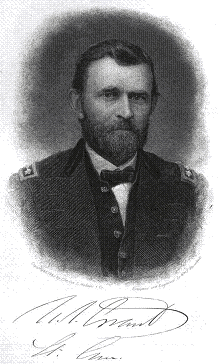
by
Ulysses S. Grant
Red and Black Publishers, St
Petersburg, Florida
Excerpted
from Personal Memoirs of General Ulysses S Grant, originally published
in two volumes, 1885
Library of Congress Cataloging-in-Publication Data
Grant, Ulysses S.
(Ulysses Simpson), 1822-1885.
[Personal memoirs of U.S. Grant]
The autobiography of General Ulysses. S. Grant :
memoirs of the Civil
War / by Ulysses
S. Grant.
p. cm.
Originally published: Personal memoirs of U.S.
Grant. New York : C.L.
Webster & Co., 1885-1886.
ISBN 978-1-934941-14-0
1. Grant, Ulysses
S. (Ulysses Simpson), 1822-1885. 2.
Generals--United States--Biography. 3. Presidents--United States--Biography. 4.
United States--History--Civil War, 1861-1865--Campaigns. 5.
United
States--History--Civil War, 1861-1865--Personal narratives. 6.
Mexican War,
1846-1848--Personal narratives.
I. Title.
E672.A3 2008
973.8'2092--dc22
2008009882
Red
and Black Publishers, PO Box 7542, St Petersburg, Florida,
33734
Contact
us at: info@RedandBlackPublishers.com
Printed
and manufactured in the United States of America
Contents
Chapter
XVII
: Outbreak Of The Rebellion
7
Chapter
XVIII: Appointed Colonel Of The 21st Illinois
13
Chapter
XIX: Commissioned
Brigadier-General
19
Chapter
XXII: Investment Of Fort Donelson
37
Chapter
XXIII: Promoted Major-General Of
Volunteers
47
Chapter
XXV
: Struck By A Bullet
63
Chapter
XXVIII: Battle Of Iuka
85
Chapter
XXXII: The Bayous West Of The Mississippi
107
Chapter
XXXVI: Investment Of Vicksburg
137
Chapter
XXXVII: Siege Of Vicksburg 143
Chapter
XXXVIII: Surrender Of Vicksburg 151
Chapter
XXXIX: Proposed Movement Upon
Mobile
161
Chapter
XL: Commanding Military Division
Of Mississippi
167
Chapter
XLIII: Preparations For Battle
187
Chapter
XLVI: Commanding The Armies Of
The United States
207
Chapter
LI: After The Battle 265
Chapter
LIII: Hancock’s Assault 277
Chapter
LIV: Battle Of North Anna
285
Chapter
LX: The Battle Of Nashville
351
Chapter
LXII: Capture Of Columbia, South
Carolina
365
Chapter
LXIV: Battle Of Five Forks
381
Chapter
LXVII: Lee’s Surrender 403
Chapter
LXIX: Johnston’s Surrender To
Sherman 417
Preface
“Man
proposes and God disposes.” There are but few important events in the affairs
of men brought about by their own choice.
Although
frequently urged by friends to write my memoirs I had determined never to do so,
nor to write anything for publication. At the age of nearly sixty-two I received
an injury from a fall, which confined me closely to the house while it did not
apparently affect my general health. This made study a pleasant pastime. Shortly
after, the rascality of a business partner developed itself by the announcement
of a failure. This was followed soon after by universal depression of all
securities, which seemed to threaten the extinction of a good part of the income
still retained, and for which I am indebted to the kindly act of friends. At
this juncture the editor of the Century Magazine asked me to write a few
articles for him. I consented for the money it gave me; for at that moment I was
living upon borrowed money. The work I found congenial, and I determined to
continue it. The event is an important one for me, for good or evil; I hope for
the former.
In
preparing these volumes for the public, I have entered upon the task with the
sincere desire to avoid doing injustice to any one, whether on the National or
Confederate side, other than the unavoidable injustice of not making mention
often where special mention is due. There must be many errors of omission in
this work, because the subject is too large to be treated of in two volumes in
such way as to do justice to all the officers and men engaged. There were
thousands of instances, during the rebellion, of individual, company, regimental
and brigade deeds of heroism which deserve special mention and are not here
alluded to. The troops engaged in them will have to look to the detailed reports
of their individual commanders for the full history of those deeds.
The
first volume, as well as a portion of the second, was written before I had
reason to suppose I was in a critical condition of health. Later I was reduced
almost to the point of death, and it became impossible for me to attend to
anything for weeks. I have, however, somewhat regained my strength, and am able,
often, to devote as many hours a day as a person should devote to such work. I
would have more hope of satisfying the expectation of the public if I could have
allowed myself more time. I have used my best efforts, with the aid of my eldest
son, F. D. Grant, assisted by his brothers, to verify from the records every
statement of fact given. The comments are my own, and show how I saw the matters
treated of whether others saw them in the same light or not.
With
these remarks I present these volumes to the public, asking no favor but hoping
they will meet the approval of the reader.
U.
S. Grant.
Mount
Macgregor, New York, July 1, 1885.
Chapter
XVII
Outbreak Of The Rebellion—Presiding At A Union
Meeting—Mustering Officer Of State Troops—Lyon At Camp Jackson—Services
Tendered To The Government.
The 4th of March,
1861, came, and Abraham Lincoln was sworn to maintain the Union against all its
enemies. The secession of one State after another followed, until eleven had
gone out. On the 11th of April Fort Sumter, a National fort in the harbor of
Charleston, South Carolina, was fired upon by the Southerners and a few days
after was captured. The Confederates proclaimed themselves aliens, and thereby
debarred themselves of all right to claim protection under the Constitution of
the United States. We did not admit the fact that they were aliens, but all the
same, they debarred themselves of the right to expect better treatment than
people of any other foreign state who make war upon an independent nation. Upon
the firing on Sumter President Lincoln issued his first call for troops and soon
after a proclamation convening Congress in extra session. The call was for
75,000 volunteers for ninety days’ service. If the shot fired at Fort Sumter
“was heard around the world,” the call of the President for 75,000 men was
heard throughout the Northern States. There was not a state in the North of a
million of inhabitants that would not have furnished the entire number faster
than arms could have been supplied to them, if it had been necessary.
As
soon as the news of the call for volunteers reached Galena, posters were stuck
up calling for a meeting of the citizens at the court-house in the evening.
Business ceased entirely; all was excitement; for a time there were no party
distinctions; all were Union men, determined to avenge the insult to the
national flag. In the evening the court-house was packed. Although a comparative
stranger I was called upon to preside; the sole reason, possibly, was that I had
been in the army and had seen service. With much embarrassment and some
prompting I made out to announce the object of the meeting. Speeches were in
order, but it is doubtful whether it would have been safe just then to make
other than patriotic ones. There was probably no one in the house, however, who
felt like making any other. The two principal speeches were by B. B. Howard, the
post-master and a Breckinridge Democrat at the November election the fall
before, and John A. Rawlins, an elector on the Douglas ticket. E. B. Washburne,
with whom I was not acquainted at that time, came in after the meeting had been
organized, and expressed, I understood afterwards, a little surprise that Galena
could not furnish a presiding officer for such an occasion without taking a
stranger. He came forward and was introduced, and made a speech appealing to the
patriotism of the meeting.
After
the speaking was over volunteers were called for to form a company. The quota of
Illinois had been fixed at six regiments; and it was supposed that one company
would be as much as would be accepted from Galena. The company was raised and
the officers and non-commissioned officers elected before the meeting adjourned.
I declined the captaincy before the balloting, but announced that I would aid
the company in every way I could and would be found in the service in some
position if there should be a war. I never went into our leather store after
that meeting, to put up a package or do other business.
The
ladies of Galena were quite as patriotic as the men. They could not enlist, but
they conceived the idea of sending their first company to the field uniformed.
They came to me to get a description of the United States uniform for infantry;
subscribed and bought the material; procured tailors to cut out the garments,
and the ladies made them up. In a few days the company was in uniform and ready
to report at the State capital for assignment. The men all turned out the
morning after their enlistment, and I took charge, divided them into squads and
superintended their drill. When they were ready to go to Springfield I went with
them and remained there until they were assigned to a regiment.
There
were so many more volunteers than had been called for that the question whom to
accept was quite embarrassing to the governor, Richard Yates. The legislature
was in session at the time, however, and came to his relief. A law was enacted
authorizing the governor to accept the services of ten additional regiments, one
from each congressional district, for one month, to be paid by the State, but
pledged to go into the service of the United States if there should be a further
call during their term. Even with this relief the governor was still very much
embarrassed. Before the war was over he was like the President when he was taken
with the varioloid: “at last he had something he could give to all who wanted
it.”
In
time the Galena company was mustered into the United States service, forming a
part of the 11th Illinois volunteer infantry. My duties, I thought, had ended at
Springfield, and I was prepared to start home by the evening train, leaving at
nine o’clock. Up to that time I do not think I had been introduced to Governor
Yates, or had ever spoken to him. I knew him by sight, however, because he was
living at the same hotel and I often saw him at table. The evening I was to quit
the capital I left the supper room before the governor and was standing at the
front door when he came out. He spoke to me, calling me by my old army title
“Captain,” and said he understood that I was about leaving the city. I
answered that I was. He said he would be glad if I would remain over-night and
call at the Executive office the next morning. I complied with his request, and
was asked to go into the Adjutant-General’s office and render such assistance
as I could, the governor saying that my army experience would be of great
service there. I accepted the proposition.
My
old army experience I found indeed of very great service. I was no clerk, nor
had I any capacity to become one. The only place I ever found in my life to put
a paper so as to find it again was either a side coat-pocket or the hands of a
clerk or secretary more careful than myself. But I had been quartermaster,
commissary and adjutant in the field. The army forms were familiar to me and I
could direct how they should be made out. There was a clerk in the office of the
Adjutant-General who supplied my deficiencies. The ease with which the State of
Illinois settled its accounts with the government at the close of the war is
evidence of the efficiency of Mr. Loomis as an accountant on a large scale. He
remained in the office until that time.
As
I have stated, the legislature authorized the governor to accept the services of
ten additional regiments. I had charge of mustering these regiments into the
State service. They were assembled at the most convenient railroad centres in
their respective congressional districts. I detailed officers to muster in a
portion of them, but mustered three in the southern part of the State myself.
One of these was to assemble at Belleville, some eighteen miles south-east of
St. Louis. When I got there I found that only one or two companies had arrived.
There was no probability of the regiment coming together under five days. This
gave me a few idle days which I concluded to spend in St. Louis.
There
was a considerable force of State militia at Camp Jackson, on the outskirts of
St. Louis, at the time. There is but little doubt that it was the design of
Governor Claiborn Jackson to have these troops ready to seize the United States
arsenal and the city of St. Louis. Why they did not do so I do not know. There
was but a small garrison, two companies I think, under Captain N. Lyon at the
arsenal, and but for the timely services of the Hon. F. P. Blair, I have little
doubt that St. Louis would have gone into rebel hands, and with it the arsenal
with all its arms and ammunition.
Blair
was a leader among the Union men of St. Louis in 1861. There was no State
government in Missouri at the time that would sanction the raising of troops or
commissioned officers to protect United States property, but Blair had probably
procured some form of authority from the President to raise troops in Missouri
and to muster them into the service of the United States. At all events, he did
raise a regiment and took command himself as Colonel. With this force he
reported to Captain Lyon and placed himself and regiment under his orders. It
was whispered that Lyon thus reinforced intended to break up Camp Jackson and
capture the militia. I went down to the arsenal in the morning to see the troops
start out. I had known Lyon for two years at West Point and in the old army
afterwards. Blair I knew very well by sight. I had heard him speak in the
canvass of 1858, possibly several times, but I had never spoken to him. As the
troops marched out of the enclosure around the arsenal, Blair was on his horse
outside forming them into line preparatory to their march. I introduced myself
to him and had a few moments’ conversation and expressed my sympathy with his
purpose. This was my first personal acquaintance with the Honorable—afterwards
Major-General F. P. Blair. Camp Jackson surrendered without a fight and the
garrison was marched down to the arsenal as prisoners of war.
Up
to this time the enemies of the government in St. Louis had been bold and
defiant, while Union men were quiet but determined. The enemies had their
head-quarters in a central and public position on Pine Street, near Fifth—from
which the rebel flag was flaunted boldly. The Union men had a place of meeting
somewhere in the city, I did not know where, and I doubt whether they dared to
enrage the enemies of the government by placing the national flag outside their
head-quarters. As soon as the news of the capture of Camp Jackson reached the
city the condition of affairs was changed. Union men became rampant, aggressive,
and, if you will, intolerant. They proclaimed their sentiments boldly, and were
impatient at anything like disrespect for the Union. The secessionists became
quiet but were filled with suppressed rage. They had been playing the bully. The
Union men ordered the rebel flag taken down from the building on Pine Street.
The command was given in tones of authority and it was taken down, never to be
raised again in St. Louis.
I
witnessed the scene. I had heard of the surrender of the camp and that the
garrison was on its way to the arsenal. I had seen the troops start out in the
morning and had wished them success. I now determined to go to the arsenal and
await their arrival and congratulate them. I stepped on a car standing at the
corner of 4th and Pine streets, and saw a crowd of people standing quietly in
front of the head-quarters, who were there for the purpose of hauling down the
flag. There were squads of other people at intervals down the street. They too
were quiet but filled with suppressed rage, and muttered their resentment at the
insult to, what they called, “their” flag. Before the car I was in had
started, a dapper little fellow—he would be called a dude at this
day—stepped in. He was in a great state of excitement and used adjectives
freely to express his contempt for the Union and for those who had just
perpetrated such an outrage upon the rights of a free people. There was only one
other passenger in the car besides myself when this young man entered. He
evidently expected to find nothing but sympathy when he got away from the “mud
sills” engaged in compelling a “free people” to pull down a flag they
adored. He turned to me saying: “Things have come to a—pretty pass when a
free people can’t choose their own flag. Where I came from if a man dares to
say a word in favor of the Union we hang him to a limb of the first tree we come
to.” I replied that “after all we were not so intolerant in St. Louis as we
might be; I had not seen a single rebel hung yet, nor heard of one; there were
plenty of them who ought to be, however.” The young man subsided. He was so
crestfallen that I believe if I had ordered him to leave the car he would have
gone quietly out, saying to himself: “More Yankee oppression.”
By
nightfall the late defenders of Camp Jackson were all within the walls of the
St. Louis arsenal, prisoners of war. The next day I left St. Louis for Mattoon,
Illinois, where I was to muster in the regiment from that congressional
district. This was the 21st Illinois infantry, the regiment of which I
subsequently became colonel. I mustered one regiment afterwards, when my
services for the State were about closed.
Brigadier-General
John Pope was stationed at Springfield, as United States mustering officer, all
the time I was in the State service. He was a native of Illinois and well
acquainted with most of the prominent men in the State. I was a carpet-bagger
and knew but few of them. While I was on duty at Springfield the senators,
representatives in Congress, ax-governors and the State legislators were nearly
all at the State capital. The only acquaintance I made among them was with the
governor, whom I was serving, and, by chance, with Senator S. A. Douglas. The
only members of Congress I knew were Washburne and Philip Foulk. With the
former, though he represented my district and we were citizens of the same town,
I only became acquainted at the meeting when the first company of Galena
volunteers was raised. Foulk I had known in St. Louis when I was a citizen of
that city. I had been three years at West Point with Pope and had served with
him a short time during the Mexican war, under General Taylor. I saw a good deal
of him during my service with the State. On one occasion he said to me that I
ought to go into the United States service. I told him I intended to do so if
there was a war. He spoke of his acquaintance with the public men of the State,
and said he could get them to recommend me for a position and that he would do
all he could for me. I declined to receive endorsement for permission to fight
for my country.
Going
home for a day or two soon after this conversation with General Pope, I wrote
from Galena the following letter to the Adjutant-General of the Army.
GALENA, ILLINOIS, May 24, 1861.
COL. L. THOMAS Adjt. Gen. U. S. A., Washington, D. C.
SIR:—Having served for fifteen years in the regular
army, including four years at West Point, and feeling it the duty of every one
who has been educated at the Government expense to offer their services for the
support of that Government, I have the honor, very respectfully, to tender my
services, until the close of the war, in such capacity as may be offered. I
would say, in view of my present age and length of service, I feel myself
competent to command a regiment, if the President, in his judgment, should see
fit to intrust one to me.
Since the first call of the President I have been
serving on the staff of the Governor of this State, rendering such aid as I
could in the organization of our State militia, and am still engaged in that
capacity. A letter addressed to me at Springfield, Illinois, will reach me.
I am very respectfully, Your obt. svt., U. S. GRANT.
This
letter failed to elicit an answer from the Adjutant-General of the Army. I
presume it was hardly read by him, and certainly it could not have been
submitted to higher authority. Subsequent to the war General Badeau having heard
of this letter applied to the War Department for a copy of it. The letter could
not be found and no one recollected ever having seen it. I took no copy when it
was written. Long after the application of General Badeau, General Townsend, who
had become Adjutant-General of the Army, while packing up papers preparatory to
the removal of his office, found this letter in some out-of-the-way place. It
had not been destroyed, but it had not been regularly filed away.
I
felt some hesitation in suggesting rank as high as the colonelcy of a regiment,
feeling somewhat doubtful whether I would be equal to the position. But I had
seen nearly every colonel who had been mustered in from the State of Illinois,
and some from Indiana, and felt that if they could command a regiment properly,
and with credit, I could also.
Having
but little to do after the muster of the last of the regiments authorized by the
State legislature, I asked and obtained of the governor leave of absence for a
week to visit my parents in Covington, Kentucky, immediately opposite
Cincinnati. General McClellan had been made a major-general and had his
headquarters at Cincinnati. In reality I wanted to see him. I had known him
slightly at West Point, where we served one year together, and in the Mexican
war. I was in hopes that when he saw me he would offer me a position on his
staff. I called on two successive days at his office but failed to see him on
either occasion, and returned to Springfield.