The
Loss Of The S. S. Titanic
Its
Story And Its Lessons
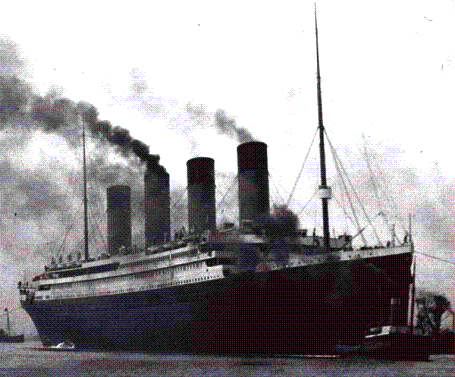
by
Lawrence Beesley
One
Of The Survivors
Red
and Black Publishers, St Petersburg, Florida
Originally published June
1912
Red
and Black Publishers, PO Box 7542, St Petersburg, Florida,
33734
Contact
us at: info@RedandBlackPublishers.com
Printed and
manufactured in the United States of America
Contents
I. Construction
And Preparations For The First Voyage
7
II. From
Southampton To The Night Of The Collision 13
III. The Collision
And Embarkation In Lifeboats
29
IV. The Sinking Of
The Titanic, Seen From A Lifeboat 45
V. The Rescue
61
VI. The Sinking Of
The Titanic, Seen From Her Deck
77
VII. The Carpathia’s
Return To New York
101
VIII. The Lessons
Taught By The Loss Of The Titanic 117
IX. Some
Impressions
141
Preface
The circumstances in
which this book came to be written are as follows. Some five weeks after the
survivors from the Titanic landed in New York, I was the guest at
luncheon of Hon. Samuel J. Elder and Hon. Charles T. Gallagher, both well-known
lawyers in Boston. After luncheon I was asked to relate to those present the
experiences of the survivors in leaving the Titanic and reaching the Carpathia.
When I had done so, Mr. Robert Lincoln
O’Brien, the editor of the Boston Herald, urged me as a matter of
public interest to write a correct history of the Titanic disaster, his
reason being that he knew several publications were in preparation by people who
had not been present at the disaster, but from newspaper accounts were piecing
together a description of it. He said that these publications would probably be
erroneous, full of highly coloured details, and generally calculated to disturb
public thought on the matter. He was supported in his request by all present,
and under this general pressure I accompanied him to Messrs. Houghton Mifflin
Company, where we discussed the question of publication.
Messrs. Houghton Mifflin Company took at that
time exactly the same view that I did, that it was probably not advisable to put
on record the incidents connected with the Titanic’s sinking: it seemed
better to forget details as rapidly as possible.
However, we decided to take a few days to
think about it. At our next meeting we found ourselves in agreement again,--but
this time on the common ground that it would probably be a wise thing to write a
history of the Titanic disaster as correctly as possible. I was supported in
this decision by the fact that a short account, which I wrote at intervals on
board the Carpathia, in the hope that it would calm public opinion by
stating the truth of what happened as nearly as I could recollect it, appeared
in all the American, English, and Colonial papers and had exactly the effect it
was intended to have. This encourages me to hope that the effect of this work
will be the same.
Another matter aided me in coming to a
decision—the duty that we, as survivors of the disaster, owe to those who went
down with the ship, to see that the reforms so urgently needed are not allowed
to be forgotten.
Whoever reads the account of the cries that
came to us afloat on the sea from those sinking in the ice-cold water must
remember that they were addressed to him just as much as to those who heard
them, and that the duty of seeing that reforms are carried out devolves on every
one who knows that such cries were heard in utter helplessness the night the Titanic
sank.
Lawrence Beesley
1912
Chapter
I
Construction
And Preparations For The First Voyage
The history of the R.M.S.
Titanic, of the White Star Line, is one of the most tragically short it is
possible to conceive. The world had waited expectantly for its launching and
again for its sailing; had read accounts of its tremendous size and its
unexampled completeness and luxury; had felt it a matter of the greatest
satisfaction that such a comfortable, and above all such a safe boat had been
designed and built—the “unsinkable lifeboat”—and then in a moment to
hear that it had gone to the bottom as if it had been the veriest tramp steamer
of a few hundred tons; and with it fifteen hundred passengers, some of them
known the world over! The improbability of such a thing ever happening was what
staggered humanity.
If its history had to be written in a single
paragraph it would be somewhat as follows:
“The R.M.S. Titanic was built by
Messrs. Harland & Wolff at their well-known ship-building works at Queen’s
Island, Belfast, side by side with her sister ship the Olympic. The twin
vessels marked such an increase in size that specially laid-out joiner and
boiler shops were prepared to aid in their construction, and the space usually
taken up by three building slips was given up to them. The keel of the Titanic
was laid on March 31, 1909, and she was launched on May 31, 1911; she passed her
trials before the Board of Trade officials on March 31, 1912, at Belfast,
arrived at Southampton on April 4, and sailed the following Wednesday, April 10,
with 2208 passengers and crew, on her maiden voyage to New York. She called at
Cherbourg the same day, Queenstown Thursday, and left for New York in the
afternoon, expecting to arrive the following Wednesday morning. But the voyage
was never completed. She collided with an iceberg on Sunday at 11.45 P.M. in
Lat. 41° 46’ N. and Long. 50° 14’ W., and sank two hours and a half later;
815 of her passengers and 688 of her crew were drowned and 705 rescued by the Carpathia.”
Such is the record of the Titanic, the
largest ship the world had ever seen—she was three inches longer than the Olympic
and one thousand tons more in gross tonnage—and her end was the greatest
maritime disaster known. The whole civilized world was stirred to its depths
when the full extent of loss of life was learned, and it has not yet recovered
from the shock. And that is without doubt a good thing. It should not recover
from it until the possibility of such a disaster occurring again has been
utterly removed from human society, whether by separate legislation in different
countries or by international agreement. No living person should seek to dwell
in thought for one moment on such a disaster except in the endeavour to glean
from it knowledge that will be of profit to the whole world in the future. When
such knowledge is practically applied in the construction, equipment, and
navigation of passenger steamers—and not until then—will be the time to
cease to think of the Titanic disaster and of the hundreds of men and
women so needlessly sacrificed.
A few words on the ship’s construction and
equipment will be necessary in order to make clear many points that arise in the
course of this book. A few figures have been added which it is hoped will help
the reader to follow events more closely than he otherwise could.
The considerations that inspired the builders
to design the Titanic on the lines on which she was constructed were
those of speed, weight of displacement, passenger and cargo accommodation. High
speed is very expensive, because the initial cost of the necessary powerful
machinery is enormous, the running expenses entailed very heavy, and passenger
and cargo accommodation have to be fined down to make the resistance through the
water as little as possible and to keep the weight down. An increase in size
brings a builder at once into conflict with the question of dock and harbour
accommodation at the ports she will touch: if her total displacement is very
great while the lines are kept slender for speed, the draught limit may be
exceeded. The Titanic, therefore, was built on broader lines than the
ocean racers, increasing the total displacement; but because of the broader
build, she was able to keep within the draught limit at each port she visited.
At the same time she was able to accommodate more passengers and cargo, and
thereby increase largely her earning capacity. A comparison between the Mauretania
and the Titanic illustrates the difference in these respects:
Displacement
Horsepower
Speed in knots
Mauretania
44,640
70,000
26
Titanic
60,000
46,000
21