Stories
from
1001
Arabian Nights
Aladdin,
Sinbad, Ali Baba, and Others
Translated
by Andrew Lang
Red
and Black Publishers, St Petersburg, Florida
Translated by Andrew Lang, 1897
Library of Congress Cataloging-in-Publication Data
Arabian nights.
English. Selections.
Stories from 1001 Arabian nights : Aladdin,
Sinbad, Ali Baba, and
others / translated by Andrew
Lang.
p.
cm.
Originally published in 1897.
ISBN 978-1-934941-07-2
I. Lang, Andrew, 1844-1912. II. Title. III. Title: Stories
from one
thousand and one
Arabian nights.
PJ7716.A1L36 2008
398.22--dc22
2008007755
Red and Black Publishers, PO Box 7542, St
Petersburg, Florida, 33734
Contact us at: info@RedandBlackPublishers.com
Printed
and manufactured in the United States of America
Contents
Prologue
5
Aladdin and the
Wonderful Lamp
11
The Seven Voyages of
Sinbad the Sailor
27
First Voyage 30
Second Voyage 35
Third Voyage 40
Fourth Voyage 46
Fifth Voyage 53
Sixth Voyage 58
Seventh Voyage 64
Ali Baba and the Forty
Thieves
71
The Story of
the Two Sisters Who Were Jealous of Their Younger Sister
81
The Fisherman and the Genie
107

Prologue
In the chronicles of
the ancient dynasty of the Sassanidae, who reigned for about four hundred
years, from Persia to the borders of China, beyond the great river Ganges
itself, we read the praises of one of the kings of this race, who was said to
be the best monarch of his time. His subjects loved him, and his neighbors
feared him, and when he died he left his kingdom in a more prosperous and
powerful condition than any king had done before him.
The two sons who survived him loved each
other tenderly, and it was a real grief to the elder, Schahriar, that the laws
of the empire forbade him to share his dominions with his brother Schahzeman.
Indeed, after ten years, during which this state of things had not ceased to
trouble him, Schahriar cut off the country of Great Tartary from the Persian
Empire and made his brother king.
Now the Sultan Schahriar had a wife whom he
loved more than all the world, and his greatest happiness was to surround her
with splendour, and to give her the finest dresses and the most beautiful
jewels. It was therefore with the deepest shame and sorrow that he
accidentally discovered, after several years, that she had deceived him
completely, and her whole conduct turned out to have been so bad, that he felt
himself obliged to carry out the law of the land, and order the grand-vizir to
put her to death. The blow was so heavy that his mind almost gave way, and he
declared that he was quite sure that at bottom all women were as wicked as the
sultana, if you could only find them out, and that the fewer the world
contained the better. So every evening he married a fresh wife and had her
strangled the following morning before the grand-vizir, whose duty it was to
provide these unhappy brides for the Sultan. The poor man fulfilled his task
with reluctance, but there was no escape, and every day saw a girl married and
a wife dead.
This behaviour caused the greatest horror in
the town, where nothing was heard but cries and lamentations. In one house was
a father weeping for the loss of his daughter, in another perhaps a mother
trembling for the fate of her child; and instead of the blessings that had
formerly been heaped on the Sultan’s head, the air was now full of curses.
The grand-vizir himself was the father of
two daughters, of whom the elder was called Scheherazade, and the younger
Dinarzade. Dinarzade had no particular gifts to distinguish her from other
girls, but her sister was clever and courageous in the highest degree. Her
father had given her the best masters in philosophy, medicine, history and the
fine arts, and besides all this, her beauty excelled that of any girl in the
kingdom of Persia.
One day, when the grand-vizir was talking to
his eldest daughter, who was his delight and pride, Scheherazade said to him,
“Father, I have a favour to ask of you. Will you grant it to me?”
“I can refuse you nothing,” replied he,
“that is just and reasonable.”
“Then listen,” said Scheherazade. “I
am determined to stop this barbarous practice of the Sultan’s, and to
deliver the girls and mothers from the awful fate that hangs over them.”
“It would be an excellent thing to do,”
returned the grand-vizir, “but how do you propose to accomplish it?”
“My father,” answered Scheherazade,
“it is you who have to provide the Sultan daily with a fresh wife, and I
implore you, by all the affection you bear me, to allow the honour to fall
upon me.”
“Have you lost your senses?” cried the
grand-vizir, starting back in horror. “What has put such a thing into your
head? You ought to know by this time what it means to be the sultan’s
bride!”
“Yes, my father, I know it well,”
replied she, “and I am not afraid to think of it. If I fail, my death will
be a glorious one, and if I succeed I shall have done a great service to my
country.”
“It is of no use,” said the grand-vizir,
“I shall never consent. If the Sultan was to order me to plunge a dagger in
your heart, I should have to obey. What a task for a father! Ah, if you do not
fear death, fear at any rate the anguish you would cause me.”
“Once again, my father,” said
Scheherazade, “will you grant me what I ask?”
“What, are you still so obstinate?”
exclaimed the grand-vizir. “Why are you so resolved upon your own ruin?”
But the maiden absolutely refused to attend
to her father’s words, and at length, in despair, the grand-vizir was
obliged to give way, and went sadly to the palace to tell the Sultan that the
following evening he would bring him Scheherazade.
The Sultan received this news with the
greatest astonishment.
“How have you made up your mind,” he
asked, “to sacrifice your own daughter to me?”
“Sire,” answered the grand-vizir, “it
is her own wish. Even the sad fate that awaits her could not hold her back.”
“Let there be no mistake, vizir,” said
the Sultan. “Remember you will have to take her life yourself. If you
refuse, I swear that your head shall pay forfeit.”
“Sire,” returned the vizir. “Whatever
the cost, I will obey you. Though a father, I am also your subject.” So the
Sultan told the grand-vizir he might bring his daughter as soon as he liked.
The vizir took back this news to
Scheherazade, who received it as if it had been the most pleasant thing in the
world. She thanked her father warmly for yielding to her wishes, and, seeing
him still bowed down with grief, told him that she hoped he would never repent
having allowed her to marry the Sultan. Then she went to prepare herself for
the marriage, and begged that her sister Dinarzade should be sent for to speak
to her.
When they were alone, Scheherazade addressed
her thus:
“My dear sister; I want your help in a
very important affair. My father is going to take me to the palace to
celebrate my marriage with the Sultan. When his Highness receives me, I shall
beg him, as a last favour, to let you sleep in our chamber, so that I may have
your company during the last night I am alive. If, as I hope, he grants me my
wish, be sure that you wake me an hour before the dawn, and speak to me in
these words: “My sister, if you are not asleep, I beg you, before the sun
rises, to tell me one of your charming stories.” Then I shall begin, and I
hope by this means to deliver the people from the terror that reigns over
them.” Dinarzade replied that she would do with pleasure what her sister
wished.
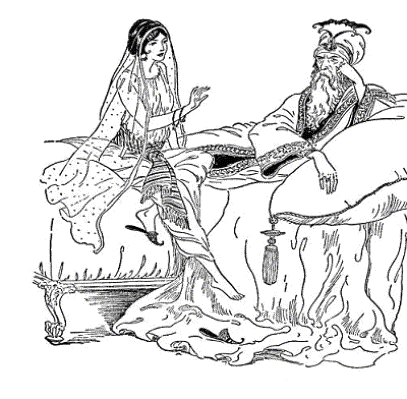
When the usual hour arrived the grand-vizir
conducted Scheherazade to the palace, and left her alone with the Sultan, who
bade her raise her veil and was amazed at her beauty. But seeing her eyes full
of tears, he asked what was the matter. “Sire,” replied Scheherazade, “I
have a sister who loves me as tenderly as I love her. Grant me the favour of
allowing her to sleep this night in the same room, as it is the last we shall
be together.” Schahriar consented to Scheherazade’s petition and Dinarzade
was sent for.
An hour before daybreak Dinarzade awoke, and
exclaimed, as she had promised, “My dear sister, if you are not asleep, tell
me I pray you, before the sun rises, one of your charming stories. It is the
last time that I shall have the pleasure of hearing you.”
Scheherazade did not answer her sister, but
turned to the Sultan. “Will your highness permit me to do as my sister
asks?” said she.
“Willingly,” he answered. So
Scheherazade began.